
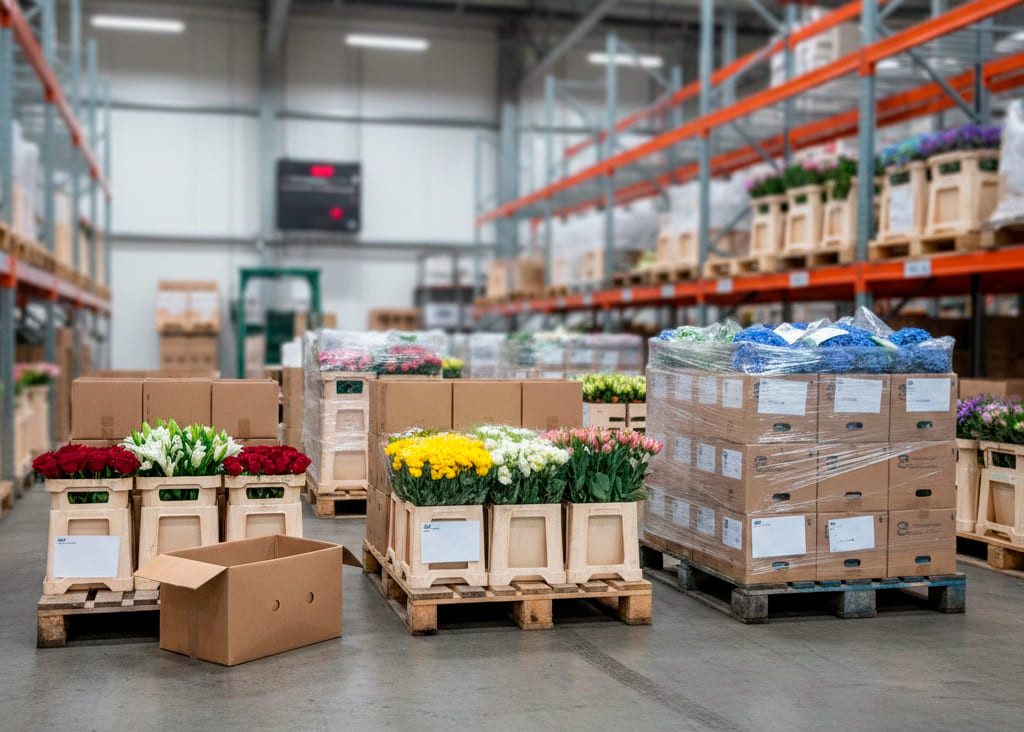
In international transportation of fresh-cut flowers, both speed and predictability are critical. Fast delivery is important on its own, but without a stable schedule it does not ensure consistent results. Regularity is what transforms individual shipments into a manageable supply system.
Flowers are a product with a limited selling window and high sensitivity to temperature and timing deviations. Even minor delays or changes in storage conditions directly affect quality and, consequently, commercial outcomes. Therefore, choosing between a one-time bulk shipment and a consistent schedule is not just a logistics decision — it directly impacts operational and financial risk levels.
One-Off Shipments Sound Efficient — But Only on Paper
The Illusion of Freight Savings
When planning a large shipment, the focus is usually on freight: higher volumes reduce the rate per unit and appear more efficient on a “per ton” basis.
However, freight is only one cost component. There are also airport handling, storage, consolidation, potential reprocessing of rejected products, and discounts required to accelerate sales. If a shipment is delayed or part of the volume loses quality, the savings on freight rates are quickly offset by additional costs.
Moreover, a large one-time shipment limits procurement flexibility. If demand shifts, adjusting volume is no longer possible — the entire financial outcome is tied to a single flight and a single time window.
Hidden Risks That Surface Later
A one-off model concentrates quality risk into a single point. A flight delay, temperature deviation during handling, or disruption at a transit hub affects the entire shipment at once.
With regular shipments, the impact of a single incident is limited to part of the volume. Even if one shipment is delayed, the next can offset the gap, reducing pressure on both inventory and sales.
Additional risk comes from operational processes. One-off shipments are often accompanied by urgent approvals, accelerated documentation, and last-minute route changes. Under pressure, the likelihood of errors increases, and the consequences become visible at the receiving end — through reduced quality or assortment inconsistencies.
Why “Occasional Shipping” Doesn’t Work for Flowers
Irregular shipments do not create a sustainable logistics model. Each shipment is effectively organized as a separate project: new approvals, new timing parameters, and no accumulated data for a specific route.
Without a stable schedule, time windows are not закреплены, actual arrival times are harder to forecast, and there is no historical data on temperature deviations or handling specifics at transit stages. This increases uncertainty for the recipient — both in sales planning and inventory management.
For a product with a limited selling window, this uncertainty directly affects turnover rates and write-offs. As a result, freight savings from one-off shipments often translate into systemic losses across the supply chain.
Regularity as a System, Not a Habit
Regularity is not just about “shipping more often.” It is a transition from isolated operations to a controlled model. When shipments follow a fixed rhythm, logistics becomes part of the company’s operational architecture rather than a set of disconnected decisions.
Operational Stability — When Everyone Knows What Comes Next
A stable schedule establishes time windows, volumes, and handling procedures. The shipper, terminal operator, airline, and consignee all operate within a predictable cycle. This reduces the share of non-standard decisions and lowers the operational workload.
Importantly, regularity does not eliminate disruptions. Delays can occur in any model. But in a structured system, they do not break the process entirely. Repetition of routes allows typical time variations to be anticipated, realistic transit times to be set, and supply chain parameters to be adjusted without restarting the entire process.
A supply chain that operates regularly adapts faster because it is already structured.
Predictable Timing and Volumes
A regular schedule turns shipments from events into processes. Procurement and sales are planned not based on assumptions, but on actual shipment frequency and real transit times.
Dividing volume into multiple batches reduces dependency on a single flight and allows for more precise assortment management. If demand changes, adjustments are made at the level of the next shipment rather than post factum in the warehouse.
This affects not only warehouse load but also procurement structure: it becomes easier to distribute volume across varieties, stem lengths, and categories without concentrating everything in one shipment. As a result, assortment control improves and turnover becomes more predictable.
Less Chaos — Fewer Emergency Decisions
An irregular model almost inevitably leads to urgent operations: last-minute volume adjustments, searching for alternative flights, and route changes under time pressure.
Each such decision increases operational costs — not only direct ones but also indirect: document reprocessing, additional cargo handling, and warehouse schedule adjustments.
With regular shipments, most processes become standardized. This does not eliminate flexibility but reduces the number of situations requiring urgent intervention. In the long term, reducing unplanned actions is what increases overall supply chain stability.
Financial Impact of Regular Shipments
Regularity is directly linked to financial performance. In the flower trade, margins are formed not only at the procurement stage but also during sales. The predictability of logistics affects both.
A large one-time shipment may appear cost-efficient on a per-unit freight basis. However, financial performance must be evaluated across the entire chain — from procurement payment to final sales.
Inventory and Write-Off Management
With a large one-time shipment, the entire volume arrives at the warehouse simultaneously. If actual demand is lower than expected or certain items sell more slowly, excess inventory accumulates.
In flowers, this means not only tied-up capital but also accelerated quality deterioration. Even under proper temperature conditions, the selling window is limited. The longer inventory remains in storage, the higher the likelihood of markdowns or write-offs.
Regular shipments allow maintaining optimal inventory levels. Batches arrive evenly, and volume can be adjusted between shipments. This reduces non-liquid stock and stabilizes actual margins.
Procurement Planning Without Stress
A stable schedule enables procurement planning across multiple periods. Decisions are made not in reaction to shortages or overstock but based on a predictable supply rhythm.
This simplifies coordination with producers: regular volumes allow better allocation across product lines and a more balanced assortment.
Additionally, splitting volumes reduces the cost of forecasting errors. If demand is lower than expected, adjustments can be made quickly in the next shipment with lower financial impact compared to a single large purchase.
Cash Gaps and Their Hidden Effects
A large one-time shipment creates significant pressure on working capital. The period between procurement payment and revenue realization can stretch, especially if sales are slower than expected.
This leads to cash gaps. They rarely appear as an immediate crisis but gradually affect the business: delaying the next procurement, reducing assortment, and increasing the share of discounted sales.
A regular model distributes financial load over time. Payments and revenues form a more balanced cash flow. This reduces dependence on external financing and makes the business less sensitive to demand fluctuations.
Partner Routes and Carrier Priority
Flower logistics is not only about routes and cost per kilogram. It is also about how consistently you are present within the system. Regularity gradually transforms one-off shipments into stable interactions between all participants: airlines, terminal operators, ground handlers, and consignees.
When shipments follow a schedule, a route stops being “occasional.” It becomes operational.
Why Consistent Volume Matters More Than Occasional Loads
For airlines, load planning is important not only for today but for the coming weeks. Regular volumes are built into planning: capacity is reserved, cargo distribution schemes are calculated, and time windows are adjusted accordingly.
An occasional shipment, even if properly documented, is perceived as additional load. During high utilization, priority is typically given to clients with predictable volumes. This is not about formal preference, but about planning logic.
Regular cargo reduces uncertainty for carriers. And reduced uncertainty leads to more stable routes.
Flight Priority Is Not Theoretical
During peak periods — before major floral events or in high-demand seasons — flight capacity reaches its limits. At that point, not only price but also relationship history matters.
All else being equal, shipment confirmation is more likely for senders with regular volumes. A one-off shipment may be moved to the next flight if capacity is limited, even if packaging and documentation meet all requirements.
For flowers, a delay of several hours or a day already impacts the remaining selling window. This directly affects shelf quality and actual margins.
Shipper Reputation Within the Chain
Regularity builds reputation not only at the airline level. In transit hubs and handling warehouses, repeated processes reduce the likelihood of errors: volumes, packaging formats, and arrival patterns become familiar.
When a route is repeated, operational teams work within a known scenario. This speeds up handling and reduces the risk of deviations.
As a result, regularity becomes a competitive advantage not through “privileges,” but through predictability across the entire chain. Predictability means control. And in flower logistics, control is directly linked to quality.
When One-Off Shipments Are Justified
A regular model is effective for long-term operations. However, this does not mean that one-off shipments have no place. In some cases, they are a logical stage in developing a direction.
The key is understanding their limitations.
Testing New Routes
Entering a new route rarely starts with a full schedule. Demand is first evaluated, actual transit times are tested, and post-arrival product performance is analyzed.
In this case, a one-off shipment serves as a hypothesis test. It provides real data on transit time, handling specifics at transit points, and market response.
However, testing should not be prolonged. If the route proves economically viable, it should transition to a regular model. Otherwise, uncertainty remains high at every stage.
One-Off Contracts and Special Projects
Certain projects — events, fixed-date contracts, seasonal orders for specific volumes — may require a single shipment.
Here, the economic logic is tied to a specific event. Volume is predefined, and timing is fixed. In this format, regularity уступает задаче «deliver by a specific date».
Nevertheless, even in one-off projects, using established routes and experienced operators significantly reduces the risk of deviations.
Risks That Must Be Understood in Advance
In a one-off model, the entire volume depends on a single flight and time window. Any disruption affects the result fully, not partially.
Additionally, financial pressure is concentrated: procurement and logistics payments occur at once, while sales are distributed over time. This increases sensitivity to demand fluctuations.
A one-off shipment may be justified, but it requires stricter planning and a clear understanding of possible scenarios. Unlike a regular model, where stability comes from repetition, here it comes from precision.
Regularity Is Not About Speed — It’s About Stability
In flower logistics, much attention is given to delivery time. This is justified: time directly affects quality. However, minimal transit time alone does not guarantee consistent results. A fast shipment organized under pressure may be less predictable than a slightly longer one integrated into a regular schedule.
Supply chain stability is the ability to operate consistently despite inevitable disruptions. This is what regularity provides.
Why a Stable Schedule Matters More Than “Urgent”
Urgent shipments solve immediate problems. They help meet tight deadlines, reduce waiting time, and address shortages. However, if every shipment is handled as urgent, the system becomes dependent on one-off decisions and external factors.
A stable schedule works differently. It sets a rhythm — for procurement, warehouse operations, and sales. Even expedited shipments are integrated into the system rather than disrupting it.
Businesses need not only fast cargo but also clarity on when the next volume will arrive and under what conditions. Predictability reduces operational pressure and enables planning instead of reactive decision-making.
How Regularity Reduces Overall Supply Chain Risk
In a regular model, the impact of a single disruption is limited. Even if a flight is delayed, the system does not stop entirely — the next shipment is already scheduled.
Route repetition provides another advantage: the actual cargo movement dynamics become clear. Real timing fluctuations, handling specifics at transit stages, and frequent delay points are identified. This allows supply chain parameters to be adjusted and reliability to improve over time.
Ultimately, stability is achieved not through ideal conditions, but through accumulated experience and standardized processes.
What Happens When the System Works
When shipments follow a stable schedule, the supply chain stops depending on random factors. Volumes are distributed, time windows are fixed, and interactions between participants are structured.
In this model, it is easier to predict shelf quality, more accurate to calculate turnover, and more effective to manage assortment. Operational teams work in a planned mode rather than constantly adjusting.
In this context, regularity is not an optional feature but a foundation. It creates competitiveness through control — and in flower logistics, control is directly linked to quality preservation and financial performance.
Ultimately, it is the stability of the entire supply chain — not the speed of a single shipment — that determines long-term efficiency.
