
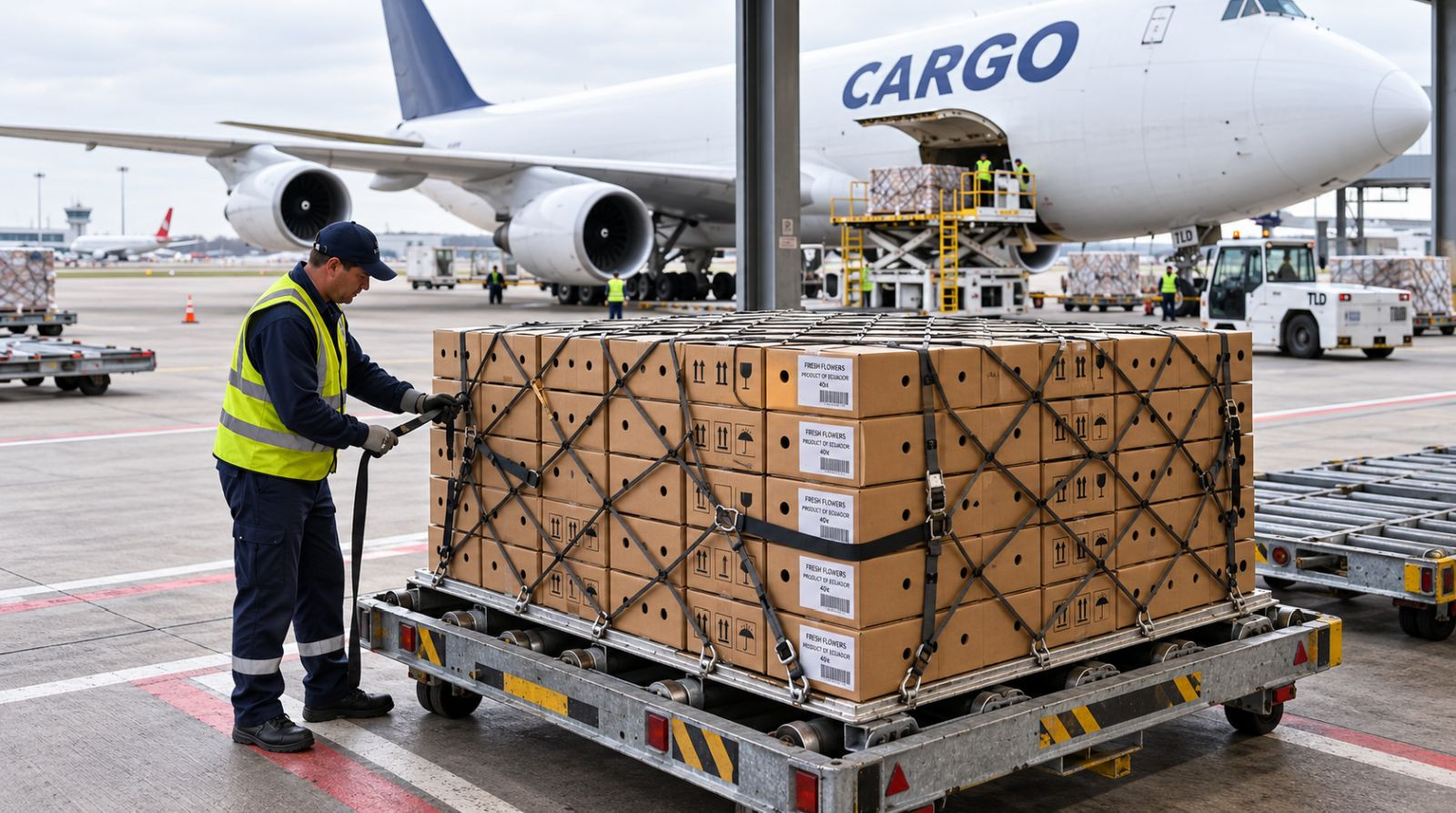
In the flower trade, the box usually stays out of sight. Buyers discuss varieties, stem length, bud size, and price, logistics teams calculate flights and airports, florists already picture the flowers in their shops, and end customers see them in a vase. Between all of them is a long cardboard box that, in practice, affects far more than it may seem.
It determines how many stems can be shipped in a single cargo piece, how efficiently aircraft cargo space is used, whether the flowers will withstand the journey, how much transportation costs per stem, and how easy the shipment is to handle at the cargo terminal. Yet the Full Box, Half Box, and Quarter Box formats commonly used in the industry do not form a single international system of standardized dimensions.
Specifications from farms in Ecuador and Colombia show that there is no single standard size for a flower box. Its dimensions depend both on the characteristics of the flowers and on the requirements of international transportation.
What Full Box, Half Box, and Quarter Box mean
The following designations are commonly used in the international cut flower trade:
- FB, Full Box
- HB, Half Box
- QB, Quarter Box
- EB, Eighth Box
- HBJ, Half Box Jumbo
- Tobacco or Tabaco
On paper, the system looks simple. It may seem that a Half Box should be half the size of a Full Box, while a Quarter Box should be one quarter of it. In actual trade, however, there is no strict metric relationship between these terms.
This does not mean that farms choose box dimensions arbitrarily. The variation still exists within the constraints of air freight logistics: box dimensions must allow cargo to be built efficiently on air cargo pallets and other ULDs. This is why commonly used lengths of around 100–105, 120, and 130 cm are not accidental. They support different loading patterns on pallets with base dimensions such as 318 × 244 or 318 × 224 cm. However, box lengths are not exact multiples of air cargo pallet dimensions. Each producer also balances width and height according to the specific flower and loading configuration.
Ecuadorian grower EcoRoses, for example, refers to HB formats as half-sized box and tobacco, offers HB boxes for roses in lengths of 100, 120, and 150 cm, and QB boxes in lengths of 80, 90, and 100 cm. The company directly links packaging selection to the balance between volume and weight and to transportation cost per stem.
Each farm has its own range of dimensions. Some growers adjust box height and width for large rose buds, others use extremely shallow boxes for chrysanthemums or longer versions for long-stem varieties. As a result, the term "standard Half Box" says very little about the actual cargo piece unless the producer, flower type, and exact dimensions are specified.
Same term, different boxes
Several current commercial specifications illustrate just how significant these differences can be.
| Country | Company | Format | Dimensions, cm | Example use |
| Ecuador | Santa Clara Gardens | QB | 100 × 28 × 18 | Roses |
| Ecuador | Santa Clara Gardens | HB | 120 × 32 × 30 | Roses |
| Ecuador | Santa Clara Gardens | HB Large | 120 × 35 × 32 | Roses |
| Ecuador | Santa Clara Gardens | HB Extra Large | 130 × 42 × 42 | Roses |
| Ecuador | Nivalia | QB | 98 × 28 × 17 | Roses, gypsophila, and other flowers |
| Ecuador | Nivalia | HB | 105 × 35 × 35 | Roses, carnations |
| Ecuador | Nivalia | HBJ | 120 × 35 × 35 | Long-stem flowers |
| Colombia | Flores Timaná | QB | 105 × 26 × 14 | Roses |
| Colombia | Flores Timaná | HB | 98 × 27 × 26 | Roses |
| Colombia | Flores Timaná | Long HB | 120 × 30 × 30 | Long-stem roses |
| Colombia | Yasa | QB | 97 × 24 × 10.5 | Chrysanthemums |
| Colombia | Yasa | HB | 104 × 25 × 25 | Chrysanthemums |
Sources: Santa Clara Gardens, Nivalia Flowers, Flores Timaná, Yasa.
These differences directly affect occupied volume and transportation parameters. Santa Clara's HB Extra Large box has roughly 4.5 times the volume of the same farm's QB. At 130 × 42 × 42 cm, its calculated volumetric weight exceeds 38 kg. This is why a commercial designation such as HB, QB, or another format does not by itself indicate the box's physical volume or chargeable weight.
At the same time, two boxes both labeled HB by different producers may differ significantly in width, height, actual capacity, and occupied cargo volume. Industry terminology indicates only an approximate packaging class, while the physical geometry remains specific to each producer.
Why flower boxes are so long
The shape of an export box is dictated by the flower itself.
A 70 or 90 cm rose cannot be bent simply to make transportation more convenient. The stem must remain straight, the bud must not bear weight, and the flowers inside the box must be secured so that they do not damage one another during handling.
After grading, stems are assembled into bunches, protected with paper, cardboard, or polymer sleeves, and packed horizontally. EcoRoses, for example, states that after grading, roses are protected with corrugated cardboard and the foliage is placed in a polymer sleeve. This type of packaging helps reduce moisture loss and the risk of mechanical damage. Packing is carried out in a cooled area at 0.5-2 °C, after which the boxes are loaded directly from the cold room into a refrigerated truck for transportation to Quito airport.
The outer box is usually made from corrugated cardboard. Avianca Cargo recommends moisture-resistant corrugated cardboard for perishable cargo because condensation may form on packaging when it moves between refrigerated rooms and warmer environments. The airline also highlights allowable content weight and the box's stacking strength.
Another critical design feature is ventilation openings at the ends of the box, or pre-cooling vents. The box is not airtight: without through-air channels, tightly packed flowers inside the cardboard can act like a thermos, retaining field heat, causing heat buildup and the development of gray mold (Botrytis).
The box therefore has to balance several competing requirements: low weight, moisture resistance, ventilation, and sufficient rigidity to withstand stacking loads.
How many flowers fit in a box
A common mistake is to look for a single number, such as "an HB holds 300 roses."
Sometimes it does hold 300. But that figure is far from universal.
Santa Clara Gardens provides a detailed specification for its 120 × 32 × 30 cm HB.
| Rose length | Number of stems |
| 40 cm | 400 |
| 50 cm | 350 |
| 60 cm | 300 |
| 70 cm | 250 |
| 80 cm | 200 |
The same physical box can hold 400 roses with 40 cm stems or only 200 roses with 80 cm stems. For the same farm's larger HB Large box, capacity ranges from 450 stems at 40 cm to 250 stems at 80 cm.
Ecuadorian supplier RAD Flowers reports an even wider range. For roses 40-50 cm long, it gives approximately 350-600 stems per HB; for 70-80 cm roses, around 200-300; for 90-100 cm roses, around 200-250; and for stems longer than 100 cm, approximately 175-200.
Capacity is influenced by more than stem length. Stem thickness, foliage volume, bud size, variety, opening stage, bunch size, and allowable pressure on the flowers inside the box all matter. A similar pattern appears in other suppliers' specifications. For example, Nivalia's HBJ specification for a 120 × 35 × 35 cm box drops from 350 stems at 50–60 cm to 250 stems at 90 cm.
As a result, two orders of roses with the same stem length may occupy different physical volumes even if the stem count is identical. As stem length increases, the chargeable cargo volume per flower can also rise significantly.
Ecuadorian packaging developed around roses
Ecuador's packaging practices cannot be considered separately from the structure of the country's flower exports.
According to Expoflores statistics for January-March 2024, roses accounted for 74% of the value of Ecuador's flower exports. Summer flowers followed at 12%, with gypsophila at 7%.
This market structure naturally influences packaging. Ecuadorian farms widely use long HB, tobacco, and enlarged formats for premium and long-stem roses. Specifications regularly include stem lengths of 70, 80, 90, and 100 cm, while some suppliers also handle stems longer than one meter.
The packer's task is clear: load enough roses to avoid transporting unnecessary air, but not so many that excessive pressure inside the box reduces flower quality.
Santa Clara Gardens specifically warns that exceeding the recommended stem count can negatively affect both the condition of the flowers and the structural integrity of the box.
High packing density therefore does not automatically translate into savings. An additional 25 or 50 stems may improve transportation cost per stem, while at the same time increasing the risk of damage by the time the box is opened in Europe.
Colombia shows another side of the market
Colombia has a much more diverse packaging system. The country exports very large volumes of cut flowers, while its product mix is not dominated by a single premium crop. According to Asocolflores, cut flower exports reached approximately $2.4 billion and 340,000 metric tons in 2025. The United States accounted for 79% of export value.
Examples from individual growers show clearly how strongly packaging depends on the specific product.
Yasa grows chrysanthemums and uses the same 104 × 25 × 25 cm HB for different groups. It holds 160 stems of large-flowered Mum chrysanthemums or 200 stems of Anastasia, Cremon, Ping Pong, Cushion, and Daisy chrysanthemums. In a 97 × 24 × 10.5 cm QB, the respective capacities are 80 and 100 stems.
Hydrangeas follow a completely different logic. For white hydrangeas, Harmony Flowers specifies QB packing of 40 stems for flower heads 16-18 cm in diameter, 30 stems for 19-22 cm, and 12 stems for 23-25 cm.
Andean Bouquet provides an even more illustrative specification. At the same 55 cm stem length, a QB may contain 72 mini hydrangeas with 8-10 cm flower heads, or only 18-21 large hydrangeas with 26-30 cm flower heads. According to the company, such boxes weigh approximately 4-8 kg depending on variety and flower size. For bulky flower crops, internal box capacity is governed almost entirely by flower morphology, making any generalized average highly unreliable.
Box weight does not tell the whole story
An export cargo piece has several different weight-related measurements, and they should not be confused.
Tare weight is the weight of the empty box and packaging materials.
Net weight is the weight of the product itself, excluding packaging.
Gross weight is the total actual weight of the cargo piece, including the box and packaging materials.
Volumetric weight is a calculated value based on the external dimensions.
Chargeable weight is the value used to calculate transportation charges under the applicable rate conditions.
Publicly available farm specifications list box dimensions and stem counts much more often than empty tare weight or exact gross weight. It is therefore not valid to take the empty weight of an HB from one catalog and treat it as representative of the entire market.
Commercial data are more useful for understanding actual ranges. RAD Flowers gives an approximate actual weight of 20-26 kg for Ecuadorian HB boxes of roses, 15-17 kg for QB boxes of alstroemeria or carnations, and 12-14 kg for QB boxes of other flowers.
Some crops can be significantly lighter. For example, the Colombian hydrangea QB from Andean Bouquet mentioned above weighs approximately 4-8 kg.
This is why discussing the "typical weight of a QB" without specifying the flower type is practically meaningless.
Air freight is not calculated by kilograms alone
In international air cargo transportation, volumetric weight is often calculated using a ratio of 6000 cm³ per kilogram, equivalent to approximately 166.7 kg per cubic meter. The exact calculation method should always be checked against the carrier's or freight forwarder's terms, so this factor should not automatically be applied, for example, to courier shipments.
The formula is:
length × width × height / 6000
Consider the actual Santa Clara box dimensions.
| Box | Dimensions, cm | Calculated volumetric weight |
| QB | 100 × 28 × 18 | 8.4 kg |
| HB | 120 × 32 × 30 | 19.2 kg |
| HB Large | 120 × 35 × 32 | 22.4 kg |
| HB Extra Large | 130 × 42 × 42 | 38.22 kg |
Actual box weight alone is not enough to estimate air freight cost.
Suppose an HB Large actually weighs 18 kg. Using a factor of 6000, its volumetric weight is 22.4 kg. If the transportation charge is based on whichever value is higher, reducing the actual weight by another two or three kilograms will not, by itself, reduce the cost.
This is particularly important for flowers. In some cases, reducing box volume is more valuable than reducing actual weight.
Nivalia's specification highlights another important point. For boxes measuring 98 × 28 × 17, 105 × 35 × 35, and 120 × 35 × 35 cm, the company lists values of 7.77, 21.43, and 24.50 kg. These figures match almost exactly the result obtained by dividing each box volume by 6000. Without additional confirmation from the supplier, they therefore should not automatically be interpreted as the actual gross weight of a specific shipment.
Any weight value listed in a packaging specification should therefore be clarified with the supplier. It may refer not to the actual box weight, but to a calculated volumetric figure.
Why long-stem roses cost more to transport
Consider an HB box measuring 120 × 32 × 30 cm. Using a factor of 6000, its calculated volumetric weight is 19.2 kg.
The farm recommends packing either 400 roses with 40 cm stems or 200 roses with 80 cm stems in this box. This is where the chargeable weight rule, based on the higher of gross and volumetric weight, comes into play:
- A box of short roses (40 cm) may contain around 400 stems, while a box of 80 cm roses may contain around 200. The external box volume remains unchanged, so the calculated volumetric weight is 19.2 kg in both cases.
- If the actual gross weight exceeds 19.2 kg, the chargeable weight will be based on actual weight. If it is below 19.2 kg and the carrier applies the higher-of-the-two rule, the charge will be based on volumetric weight.
- Even if, for simplicity, the same chargeable weight of 19.2 kg is assumed in both cases, 400 short roses correspond to 0.048 kg of chargeable weight per stem, while 200 long roses correspond to 0.096 kg. Simply because fewer stems fit into the box, the logistics weight burden per long rose can therefore be twice as high.
In this example, each long stem carries twice as much chargeable weight as each short stem: 0.096 versus 0.048 kg.
This effect is rarely visible directly in farm price lists, but it can significantly affect the importer's logistics cost per stem.
When a few centimeters change pallet utilization
After consolidation, boxes must be loaded onto an air cargo pallet or into an air cargo container.
Avianca Cargo, for example, lists base dimensions of 318 × 244 cm for a P6P/PMC pallet and 318 × 224 cm for a P1P/PAG pallet. Permitted weight and height depend on the pallet type, aircraft, and its position in the aircraft.
At this stage, even a few centimeters can matter.
In practical terms, the entire flower packaging industry is solving a three-dimensional Tetris problem around PMC and PAG pallet dimensions. Several recurring box-length ranges are common in the market, but there is no universal standard. This means that all three dimensions, length, width, and height, matter when building a pallet.
If a box is just 2–3 cm wider than the planned module, one more cargo piece may no longer fit in the row, leaving the air cargo unit to carry empty space. If the box is longer, the basic interlocking pattern may have to be changed. An unfavorable mix of box dimensions from different farms in a consolidated shipment can leave part of the pallet footprint unused.
Packaging efficiency therefore cannot be judged only by the number of stems in each box. It also matters how many boxes can be placed on the pallet and how much chargeable cargo volume ultimately corresponds to each stem.
This is why flower growers retain several HB sizes instead of using a single universal large box. The largest box is not always the most economical option.
Dry transportation and hydration in transit
Most intercontinental flower transportation is built around pre-hydration, pre-cooling, and dense packing. After cutting, flowers are treated, packed into boxes, and shipped without free water.
A key stage in this process is pre-cooling, including forced-air cooling. A pallet or group of boxes is positioned next to a forced ventilation system that creates a pressure differential and pulls cold air through the boxes via the ventilation openings. Cooling speed depends on box design, total vent area, flower packing arrangement, and airflow intensity. Research on cut roses shows that forced-air cooling can accelerate cooling many times over compared with conventional slow cooling, while vent size has a noticeable effect on process efficiency.
The effectiveness of this method depends heavily on proper airflow management. When boxes are stacked, their ventilation openings must not be blocked, and the loading pattern must allow cold air to pass through the shipment. If air circulation is substantially restricted, pre-cooling becomes less effective and the risk of a temperature excursion increases even before departure.
Systems also exist in which flowers are transported with continuous access to water. One of the best-known examples is Pagter's Procona. It is a reusable system consisting of a water container, protective sleeve, and ventilated lid. The Valencia format has a modular 30 × 40 cm base. This allows the containers to be packed efficiently both into air cargo ULDs, for example on a PMC pallet, and later transferred without repacking onto standard Euro pallets measuring 80 × 120 cm, eight units per layer, for road distribution within Europe.
For air freight where free water is undesirable or restricted by transportation conditions, Pagter offers a special sponge capable of maintaining flower hydration for one to two days when the required temperature is maintained.
Dry packing reduces actual cargo weight and generally provides higher loading density. However, this does not necessarily result in a proportional reduction in air freight cost: if chargeable weight is determined by volume, reducing actual weight may not change the transportation charge. A water-based system adds weight and volume, but helps maintain flower condition and may reduce downstream handling in some cases.
Which option is more economical depends on the flower type, route, transit time, and downstream distribution model.
Who decides how many stems go into a box
Box fill is not determined by the grower alone.
The grower knows the product best and determines the technically acceptable packing density. The grower understands how many stems of a specific variety can be packed without creating excessive risk for buds and stems.
The buyer, in turn, may specify stem length, bunch size, assortment, flower quantity, and order format. The exporter or consolidation company combines shipments from different growers into a single consignment. The freight forwarder matches the cargo to a flight, rate, and available capacity. The airline sets requirements for cargo acceptance and loading on a specific aircraft.
Another participant becomes involved at the terminal: the ground handling operator. For this operator, the box is one of hundreds or thousands of cargo pieces that must be unloaded, moved, broken down, sorted, and rebuilt into shipments within a limited time.
Actual box weight and contents are therefore determined not by a single industry standard, but by a combination of flower characteristics, buyer requirements, and transportation conditions.
When flower box weight becomes a safety issue
The more densely a box is packed, the more economical transportation may appear on a per-stem basis. But there is a physical limit to these savings: boxes have to be removed from pallets, carried, sorted, and stacked again at cargo terminals. A long flower box is inherently more difficult to handle than a compact cargo piece of the same weight because it is harder to keep close to the body and move safely in confined spaces.
This is the context in which a 23 kg reference sometimes appears in the industry. It is not a statutory maximum box weight in the Netherlands and does not prohibit heavier cargo pieces. The Dutch Arboportaal explicitly states that the law does not set a single maximum weight for manual lifting. The 23 kg figure is used in the NIOSH method as a reference load under ideal conditions. In actual work, the acceptable load decreases depending on load position, lifting frequency, lifting height, the need to twist the body, and grip quality. For flower logistics, therefore, the important issue is not the number itself but how a specific box will be handled throughout the supply chain.
The journey of the box from farm to importer
A single box passes through several very different stages.
After cutting, flowers undergo initial treatment and cooling, followed by grading, hydration, and packing. The exact sequence varies by grower. EcoRoses, for example, uses a separate pre-cooling area after flowers arrive from the field, while subsequent hydration and packing operations are carried out in a cooled room at 0.5–2 °C. After packing, the boxes are transported to the airport while maintaining the cold chain.
The cargo then moves to an exporter or consolidation company. Shipments from different growers may be combined into a single consignment. The next stage is the airport and the build-up of the air cargo pallet. At this point, external box dimensions, stacking strength, the overall pallet contour, and aircraft-specific restrictions all become important.
After the flight, the process runs in reverse. The pallet is broken down, boxes are sorted by consignee, repacked if necessary, and moved onward through the cold chain to the importer or wholesaler.
At each stage, the same box is evaluated according to different criteria. The farm focuses on flower condition, the airline on volume and weight, the terminal operator on handling efficiency and safety, and the importer on the number and quality of saleable stems after the box is opened.
Packaging therefore cannot be optimized solely around the priorities of a single participant in the supply chain.
What buyers should check
For a procurement specialist or importer, the designation QB or HB alone provides too little information. It is much more useful to request a concise packaging specification from the supplier.
| Parameter | What to confirm |
| Box format | QB, HB, HBJ, EB, or another format |
| External dimensions | Length × width × height |
| Product | Flower type and variety |
| Stem length | In centimeters |
| Stems per bunch | Quantity |
| Bunches per box | Quantity |
| Total stems | Total quantity |
| Gross weight | Actual total box weight |
| Volumetric weight | If specified by the supplier |
| Packing method | Dry packing, hydration system, etc. |
It is particularly important not to confuse gross weight with volumetric weight. For flower cargo, the difference between the two can determine whether reducing the actual box weight produces any savings in air freight.
A professional question to the supplier is not "What size is your Half Box?" but rather: "What are the external dimensions, actual weight, and stem count for this variety and stem length?"
Only then can the actual transportation cost be calculated.
The box as a unit of flower logistics economics
It is easy to reduce the packaging problem to a single objective: fit as many stems as possible into the box. In actual logistics, however, this approach quickly stops working.
Packing too tightly increases the risk of damage. Packing too loosely means paying to transport air. A larger box can reduce cardboard consumption per stem, but may use air cargo pallet space less efficiently. A lighter box is easier to handle manually, but it is not necessarily cheaper to transport. A long premium rose costs more, while also occupying more cargo volume per stem.
Optimal packaging therefore depends on balancing several factors:
flower quality + stem count + volume + actual weight + box strength + pallet utilization + handling efficiency + transportation cost.
A universal Full Box is not necessary in such a system: optimal packaging dimensions vary according to the product and transportation conditions.
A 90 cm Ecuadorian rose, a Colombian hydrangea with a 28 cm flower head, and a chrysanthemum from the Bogotá Savanna require different boxes. What matters is that each box carries the flowers across the ocean without loss of quality while remaining economically viable across the supply chain.
Sources
- Santa Clara Gardens, box specifications
- Nivalia Flowers, packaging specifications
- EcoRoses, flower handling and packing
- Harmony Flowers, hydrangea packing specifications
- Flores Timaná, packaging specifications and logistics
- Yasa, chrysanthemum packaging
- Andean Bouquet, hydrangea packaging and weight
- RAD Flowers, box capacity and weight
- Avianca Cargo, packaging requirements
- Avianca Cargo, air cargo pallets and ULDs
- Pagter, Procona system
- Arboportaal, requirements for lifting and carrying loads
- Expoflores, Termómetro exportador florícola, January-March 2024
- Asocolflores, Informe del Presidente 2025
