
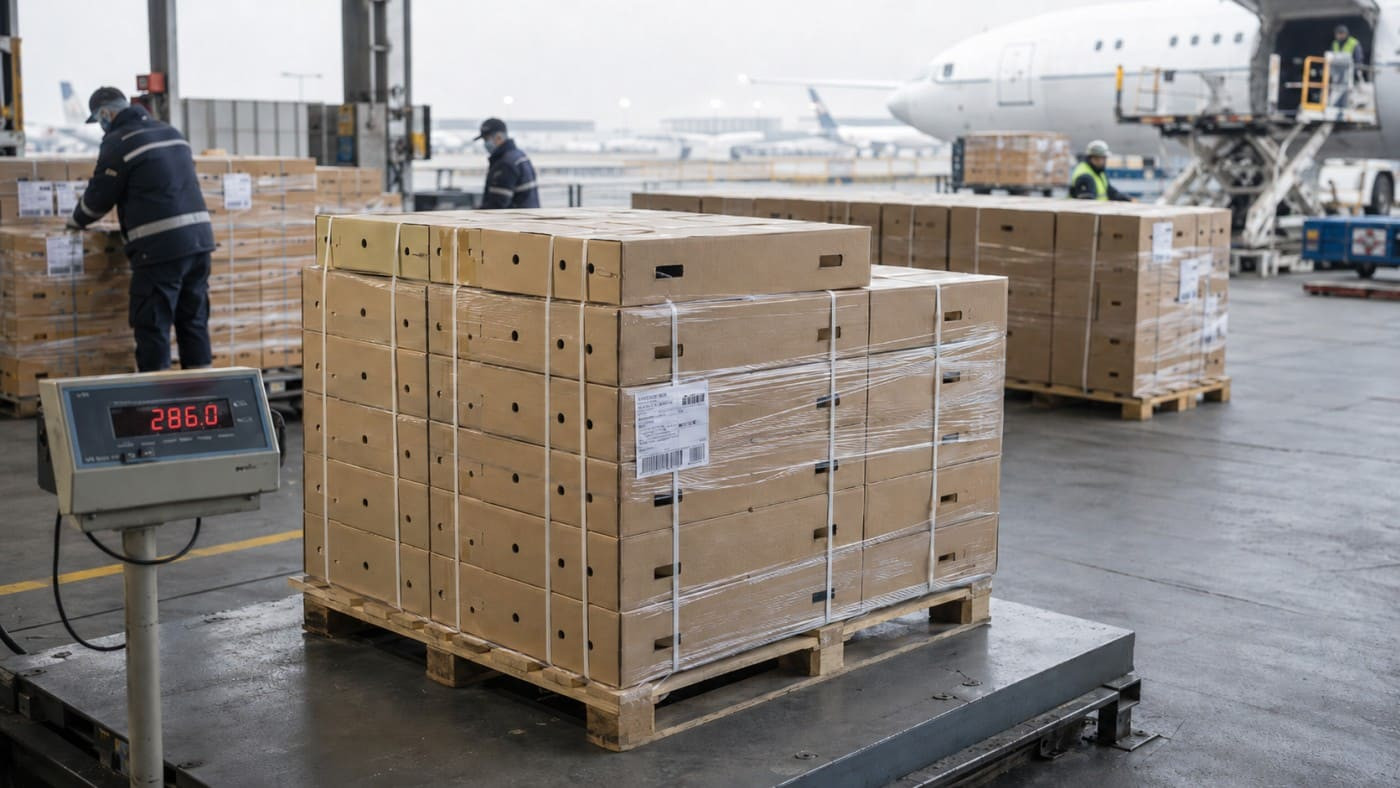
Fresh-cut flowers do not always seem like a heavy cargo. A box of roses, filler greens, or a mixed assortment may weigh relatively little but occupy significant space in an aircraft's cargo hold. For air freight, this is fundamental: the carrier considers both the mass and the dimensions of the shipment.
In flower logistics, packaging cannot be evaluated solely from a space-saving perspective. Flowers must be protected from crushing, creasing, overheating, chilling, and loss of merchantable appearance. Packing boxes tighter just to reduce chargeable weight might save on freight costs but result in higher losses due to product damage.
Therefore, a preliminary flower air freight budget cannot be based solely on actual weight. For wholesale shipments, box dimensions, packing density, and estimated chargeable weight are critical. Miscalculating these metrics affects the batch's landed cost, procurement profitability, and the accuracy of comparing different transport options.
Table of Contents
- What Is Volumetric Weight in Air Freight
- Actual, Volumetric, and Chargeable Weight: What Is the Difference
- How Volumetric Weight Is Calculated in Air Freight
- Calculation Example for a Single Flower Box
- What This Means for the Shipment Budget
- Why Volumetric Weight Is Especially Critical for Fresh-Cut Flowers
- How Volumetric Weight Affects Flower Air Freight Costs
- What Changes with Palletization and Cargo Unit Build-Up
- Why the Preliminary Estimate May Change at the Terminal
- Typical Errors in Calculating Volumetric Weight
- How to Estimate the Volumetric Weight of a Flower Shipment in Advance
- How to Reduce Excess Expenses Without Risking Flower Quality
- How to Account for Volumetric Weight When Planning Transportation
- When Volumetric Weight Is Most Critical
- Pre-Shipping Checklist for Flower Air Freight
- FAQ
What Is Volumetric Weight in Air Freight
Volumetric weight (also known as dimensional weight) is a calculated metric that links a shipment's size to its mass. It indicates how much space a shipment occupies in an aircraft relative to its actual weight. In air freight, the carrier considers both parameters: mass and volume.
For the carrier, this is not a formality. An aircraft is limited by two resources: payload capacity and available cargo hold space. A shipment may be light in weight but occupy so much volume that no space is left for other cargo. In such a scenario, billing solely by kilograms on the scale does not reflect the actual flight utilization.
In flower supply chains, a box rarely serves merely as packaging. It simultaneously defines the shipment's dimensions and protects stems, buds, and greens from damage. Long stems require elongated boxes, filler greens occupy volume with little mass, and protective packaging adds space around the product. Consequently, the volumetric weight of flowers often exceeds their actual weight, making a preliminary estimate based strictly on "box weight" understated.
Why Actual Weight Alone Is Not Enough
Actual weight only shows the total mass of the shipment. It does not answer how much space the boxes will occupy in the aircraft. For air freight, this is insufficient: the cargo hold can reach its volumetric capacity before the aircraft hits its maximum payload limit.
Therefore, the carrier compares actual weight and volumetric weight. For flower boxes, this means one simple thing: a low mass does not guarantee low shipping costs if the shipment is large in size. A wholesale buyer or importer needs to understand both the scale weight and the space the cargo will occupy well in advance.
Actual, Volumetric, and Chargeable Weight: What Is the Difference
When calculating flower air freight, three metrics must be distinguished. Actual weight is the physical mass of the cargo on the scale. Volumetric weight is a calculation based on packaging dimensions. Chargeable weight (or billable weight) is the metric to which the freight rate is applied.
Errors often arise right at the booking stage. The shipper specifies the actual weight of the boxes but provides rough dimensions or omits them entirely. As a result, the preliminary cost appears lower than the calculation after dimensions are clarified. This is particularly risky for a flower shipment: boxes with long stems, greens, or mixed assortments can be light yet occupy a significant volume.
| Metric | What It Means | Why It Matters |
|---|---|---|
| Actual Weight | The physical mass of the cargo on the scale | Required to monitor shipment mass |
| Volumetric Weight | A calculated metric based on packaging dimensions | Indicates how much space the cargo occupies |
| Chargeable Weight | The weight used to calculate the freight charge | Determines the final transportation cost |
In the IATA Cargo Agent's Handbook, chargeable weight and critical dimensions are classified as essential air cargo documentation data. For a flower buyer, this is not a formality but an integral part of calculating procurement economics: if dimensions are specified inaccurately, the preliminary budget may not match the final invoice.
What Is Chargeable Weight
Chargeable weight is the weight used to determine the shipping cost. It matches the actual weight if the shipment is sufficiently dense. However, if the boxes occupy a lot of space relative to their small mass, the volumetric weight becomes the chargeable weight.
Therefore, the rate per kilogram alone does not reveal the final cost. When comparing offers, it is crucial to understand which metric the rate applies to: actual weight, volumetric weight, or the already calculated chargeable weight.
How Volumetric Weight Is Calculated in Air Freight
For a rectangular box, volumetric weight is calculated using the formula:
Volumetric Weight (kg) = Length × Width × Height / 6000
Dimensions are specified in centimeters, and the result is obtained in kilograms. If a shipment consists of several identical boxes, you can calculate the volumetric weight of one box and multiply it by the total quantity. If the shipment contains different packaging types, calculations must be done for each group separately: for example, long boxes with roses, boxes with filler greens, and boxes with a mixed assortment.
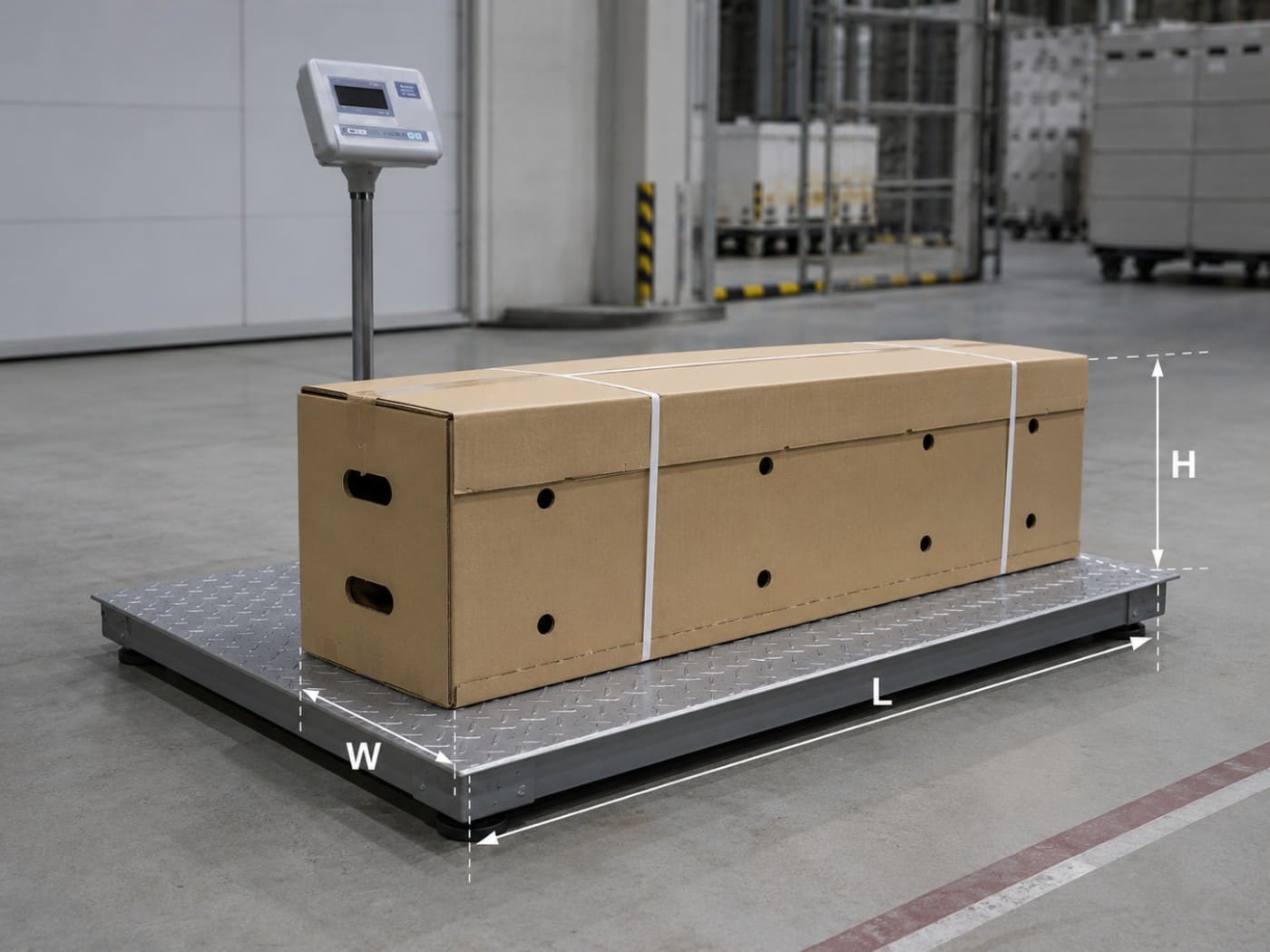
In IATA materials on air cargo tariffs and rules, a calculation is provided where volume in cubic centimeters is divided by 6000, and the higher value between actual and volumetric weight may be used for rating. The same logic can be expressed in cubic meters: 1 m³ ≈ 167 kg of volumetric weight.
The 6000 divisor should not be taken as a universal standard for every shipment. In the formula, it acts specifically as a divisor, but in tariff practices, it is often described as a volume-to-weight conversion factor. The specific factor depends on the carrier, route, service type, tariff rules, and contractual terms. While this benchmark is useful for a preliminary budget, it must be verified against the carrier's specific terms before final calculations.
Where the Benchmark 1 m³ ≈ 167 kg Comes From
The correlation is simple: 1 m³ = 1,000,000 cm³. Using the formula with the 6000 divisor yields:
1,000,000 / 6000 ≈ 166.67 kg
This gives rise to the rounded benchmark of 167 kg per 1 m³. This is neither the physical weight of air nor a characteristic of the flowers themselves; it is a tariff benchmark for cargo density. If one cubic meter of a shipment weighs less than this value, the volumetric weight may exceed the actual weight.
Why the Conversion Factor May Vary
In flower air freight, traditional air cargo transportation must be distinguished from express and courier delivery. While air cargo often uses the 6000 divisor, parcel and express schemes may operate under different rules. For instance, these schemes might use a 5000 divisor, which yields a higher volumetric weight for the same dimensions.
It is an error to automatically apply courier delivery rules to a wholesale shipment of fresh-cut flowers. Such shipments may involve entirely different conditions for acceptance, packaging, handling, air waybills, and rating. Therefore, when making calculations, you must look not just at the formula, but at the specific transport scheme to which it applies.
Calculation Example for a Single Flower Box
Suppose a flower box has the following parameters:
- length — 100 cm;
- width — 40 cm;
- height — 30 cm;
- actual weight — 12 kg.
Volumetric weight calculation:
100 × 40 × 30 / 6000 = 20 kg
The actual weight of the box is 12 kg. The volumetric weight is 20 kg. For freight calculation, 20 kg may become the chargeable weight because this value is higher than the actual mass.
For a procurement specialist, this is not a minor mathematical detail. If the preliminary budget was based solely on 12 kg, the air freight cost will be underestimated even before a route is selected. While the difference seems moderate for a single box, across a shipment of dozens of boxes, it quickly translates into a notable increase in landed cost.
What This Means for the Shipment Budget
On a single box, the difference between actual and volumetric weight might seem minor. Scaled up to an entire shipment, it turns into a direct discrepancy between the planned budget and the actual cost of transport. Thus, volumetric weight matters not only to the logistics coordinator but also to the procurement specialist: the batch's landed cost and retail profitability depend on it.
Suppose a shipment consists of 50 flower boxes. The dimensions of one box are 100 × 40 × 30 cm, and the actual weight is 12 kg. The volumetric weight per box according to the formula is 20 kg.
| Metric | Calculation | Value |
|---|---|---|
| Actual weight of one box | — | 12 kg |
| Volumetric weight of one box | 100 × 40 × 30 / 6000 | 20 kg |
| Actual weight of 50 boxes | 12 × 50 | 600 kg |
| Volumetric weight of 50 boxes | 20 × 50 | 1000 kg |
| Estimated chargeable weight | higher value between 600 and 1000 kg | 1000 kg |
If the freight rate is €3.5 per kg of chargeable weight, a calculation based solely on actual weight will yield an underestimated figure:
| Calculation Option | Weight for Tariff | Rate | Freight Cost |
|---|---|---|---|
| Erroneous calculation based on actual weight only | 600 kg | €3.5/kg | €2,100 |
| Calculation based on chargeable weight | 1000 kg | €3.5/kg | €3,500 |
| Budget discrepancy | — | — | €1,400 |
A difference of €1,400 is not an abstract logistical adjustment. If it was not budgeted in advance, it directly reduces the shipment's profit margin or forces a retail price review after procurement.
Suppose the cost of the flowers is €8,000, planned logistics is €2,100, and the selling price of the batch is €12,000. Under this calculation, the expected gross profit is €1,900.
After recalculating the freight based on chargeable weight, logistics costs increase to €3,500. The total landed cost of the shipment becomes €11,500, and the gross profit drops to €500.
| Metric | Planned Calculation | After Chargeable Weight Accounted |
|---|---|---|
| Cost of flowers | €8,000 | €8,000 |
| Freight cost | €2,100 | €3,500 |
| Total landed cost | €10,100 | €11,500 |
| Batch selling price | €12,000 | €12,000 |
| Gross profit | €1,900 | €500 |
| Profit margin relative to selling price | 15.8% | 4.2% |
In this example, the difference in chargeable weight eats up nearly three-quarters of the expected profit. For regular shipments, such an error becomes a systemic flaw in the procurement model rather than a one-time adjustment.
Why Volumetric Weight Is Especially Critical for Fresh-Cut Flowers
Fresh-cut flowers cannot be evaluated like standard boxed cargo. For many manufactured goods, packaging is designed strictly around maximizing density. In flower logistics, it works differently: packaging must protect the product, preserve its merchantable appearance, and avoid introducing extra risks to quality. In the IATA Perishable Cargo Regulations, flowers fall into a category where packaging, labeling, documentation, and correct handling at all stages of transport are vital.
Flowers often have a low density: stems, buds, and filler greens occupy space but do not always yield a heavy actual weight. Empty space may be left inside the box to prevent the product from being crushed. Protective elements, ventilation holes, and temperature control requirements also affect packaging dimensions.
For flowers, volumetric weight is linked not only to the tariff but also to the condition of the shipment after transport. If boxes are packed tightly to reduce volume without considering the flower variety, stem length, and bud sensitivity, savings on freight can result in a loss of merchantable appearance. In practical planning, it is always a balance: dimensions must be reasonable, but packaging must not become a source of damage.
Quality is also affected by the external context of transportation: temperature, terminal wait times, rehandling, and seasonal conditions. Therefore, when evaluating packaging and dimensions, it is worth considering not just the volumetric weight calculation, but also how weather affects fresh flower logistics. The USDA ARS Handbook on the Commercial Storage of Fruits, Vegetables, and Florist and Nursery Stocks treats storage, cooling, and handling as critical factors for maintaining postharvest quality.
Long Stems, Filler Greens, and Mixed Shipments
Different types of flower products yield varying packaging densities. Long-stemmed roses require elongated boxes: even with a moderate actual weight, the length of the package increases the volumetric weight. The UNECE Standard for Fresh Cut Roses treats roses as a distinct product category with specific requirements for quality, presentation, and grading.
Filler greens and filler flowers often occupy a lot of space relative to their light mass. Mixed shipments are harder to predict: an identical number of boxes can yield different chargeable weights depending on the assortment, stem lengths, packing density, and protective packaging. The list of UNECE standards for fresh-cut flowers clearly shows that flower products are highly diverse, meaning they cannot be treated as a single, uniform commodity group for packaging and transport.
Why Packaging Cannot Simply Be Reduced
Reducing volume must not compromise the quality of the shipment. Excessive packing density increases the risk of crushed buds, creased stems, damaged filler greens, and poor ventilation inside the box. For fresh-cut flowers, protective packaging is not a decorative element; it is essential to preserving merchantable quality.
The goal is not to find the smallest possible box, but to balance protection, density, and cost. If packaging becomes too tight, the shipment may formally look more economical in terms of volumetric weight, but it will actually lose quality en route. For a flower shipment, this is poor economics: damaged flowers, claims, and write-offs can cost far more than a reasonably selected box volume.
How Volumetric Weight Affects Flower Air Freight Costs
Air freight costs are frequently calculated based on chargeable weight rather than the actual mass of the boxes. If the volumetric weight exceeds the actual weight, the tariff is applied to the volumetric metric. Therefore, it is critical for flower shipments to know both the scale weight and the box dimensions in advance.
Two shipments can have the same actual weight but different costs if one batch is packed compactly while the other occupies more space in the cargo hold. A rate per kg without understanding the chargeable weight provides an incomplete picture. The calculation must show both the rate and the base metric to which it applies.
| Scenario | Actual Weight | Volumetric Weight | Chargeable Weight | What It Means |
|---|---|---|---|---|
| Compactly packed shipment | 100 kg | 85 kg | 100 kg | Billed by actual weight |
| Lightweight, bulky boxes | 100 kg | 145 kg | 145 kg | Billed by volumetric weight |
| Balanced packaging | 100 kg | 105 kg | 105 kg | The difference is minor, but must be accounted for |
Why the Rate per Kilogram Does Not Equal the Final Cost
The rate per kilogram is only part of the calculation. If one offer quotes a tariff of €4/kg and another quotes €4.5/kg, the first is not necessarily cheaper. The outcome depends on the chargeable weight, included operations, routing, and cargo handling conditions.
Without accurate dimensions, comparing tariffs becomes guesswork. For an importer or procurement specialist, this poses a risk: profitability may drop not due to the price of the flowers, but due to incorrectly assessed logistics. Therefore, when choosing a reliable shipping route for flowers, you must compare both the rate and the calculation base.
What Changes with Palletization and Cargo Unit Build-Up
Calculating by individual boxes is useful at an early stage, but palletization introduces another level: the final cargo unit. In air freight, what matters is not just the size of each box, but the outer contour of the built-up unit. If boxes are stacked with gaps, overhang the pallet edges, are wrapped in extra stretch film, or are covered with thermal insulation, the actual dimensions of the shipment can increase.
This is highly sensitive for air freight because air pallets, containers, nets, and tie-down equipment are used not merely as packaging, but as tools for securing and placing cargo on board. The IATA ULD Regulations outline the requirements for these cargo units. Therefore, when planning a shipment, it is important to consider not just the boxes, but how they will be assembled, secured, and handed over for handling.
The same logic applies beyond the flight leg. Flowers may pass through warehouses, terminals, road transport segments from the airport, and other stages of the chain. If a shipment involves multimodal flower logistics, an inefficient cargo unit configuration affects not only the air freight calculation but also handling, reloading, and subsequent placement. The IATA Cargo Handling Manual describes the sequence of operations from booking and acceptance to warehouse handling, loading, departure, and cargo release.
When the Sum of the Boxes Does Not Equal the Total Shipment Volume
If ten boxes are calculated individually, it does not guarantee that the final cargo unit will yield the same volume. Stacking can create voids, overhanging edges, an uneven top layer, or require additional protection and insulation. The outer contour of the pallet becomes larger than the arithmetic sum of the neatly measured boxes.
Therefore, while a preliminary calculation by box is necessary, it cannot be treated as the final model. For a palletized shipment, you must verify the actual dimensions of the built-up cargo unit: length, width, height, stacking stability, and the presence of additional materials.
Why the Preliminary Estimate May Change at the Terminal
The preliminary estimate is based on parameters provided by the shipper before transport: weight, dimensions, box count, packaging type, and shipment build-up method. At the terminal, these parameters may be verified. Cargo can be reweighed, remeasured, accepted directly on a pallet, overpacked, insulated, or rebuilt for safe handling. If dimensions or mass change as a result, the estimated chargeable weight changes too.
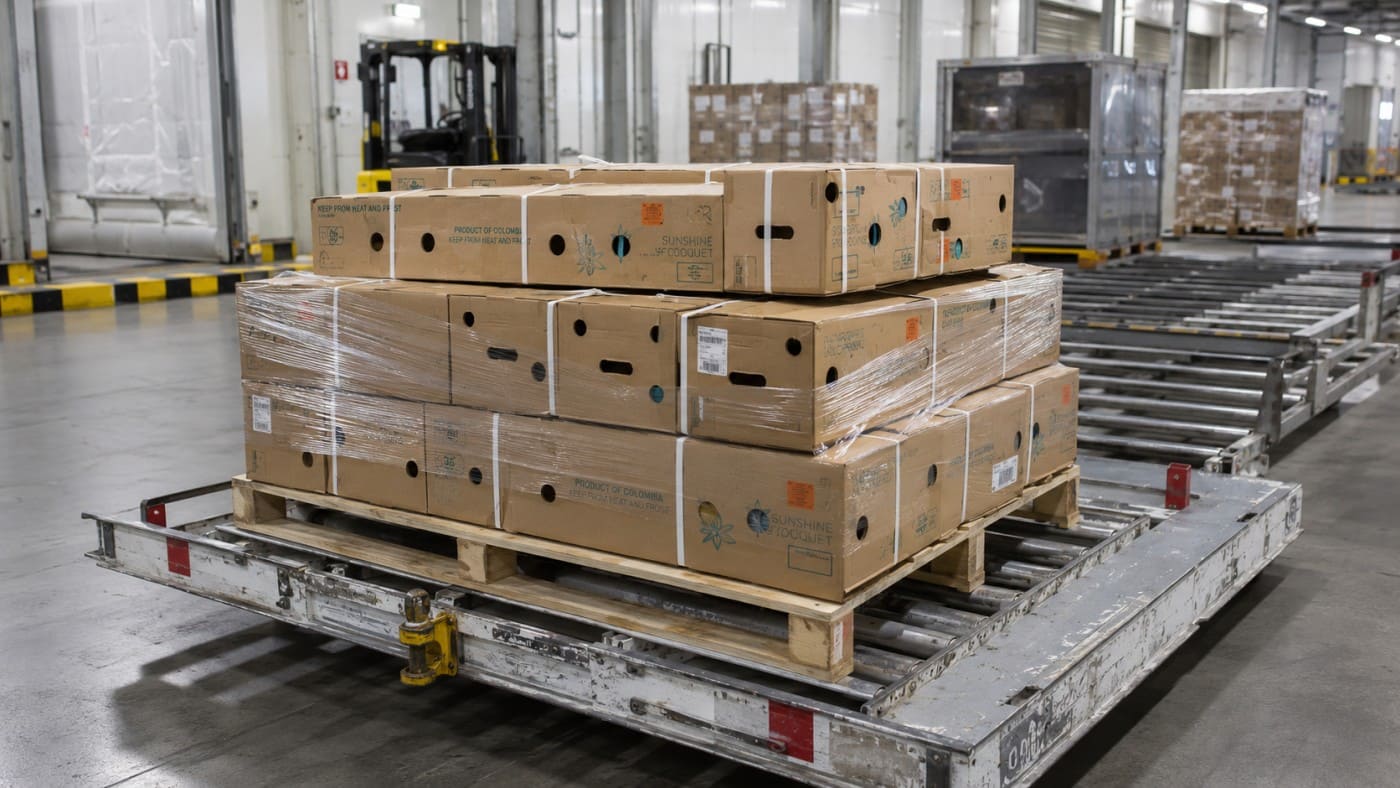
For flower products, such adjustments are often driven not by formula errors, but by the physical preparation of the cargo. In winter, thermal insulation may be added. If the packaging is weak, protective overpacking might be required. If boxes are deformed, have protruding elements, or are stacked unevenly on the pallet, the dimensions at the terminal will differ from those specified in the booking.
The preliminary calculation establishes an expected expense range but does not replace the final rating after cargo acceptance. The more precise the initial parameters, the smaller the discrepancy between expectations and the actual invoice. In air cargo documentation, chargeable weight, dimensions, and shipment volume are critical parameters, so they should never be replaced by rough estimates for a flower batch.
Which Data Is Most Critical to Specify Accurately
If a booking only specifies kilograms, the calculation is incomplete. A preliminary assessment requires parameters that reveal both the mass and the volume of the shipment:
- the number of boxes of each type;
- the dimensions of each box group;
- the actual weight of the boxes or the entire shipment;
- packaging type;
- presence of a pallet;
- need for thermal insulation;
- shipping route/destination;
- transport scheme;
- temperature and handling requirements.
This information is not a mere formality. It determines which weight might become chargeable and how realistic the shipment budget will be. The more complex the assortment and packaging, the more hazardous it is to calculate freight based solely on actual weight.
Typical Errors in Calculating Volumetric Weight
Errors in calculations rarely stem from the formula itself. More often, the problem lies in the source parameters: boxes are not fully counted, dimensions are estimated roughly, the pallet is omitted, and the carrier's offer is compared solely by the rate per kilogram. For flowers, such inaccuracy quickly turns into a financial risk because the constraint may be space in the cargo hold rather than mass.
Before making a calculation, you must verify not only the weight but also the packaging configuration. This is particularly true for mixed shipments, long boxes, filler greens, insulation, and overpacking prior to dispatch.
- Counting only actual weight. Weight on the scale does not show how much space a shipment will occupy in the aircraft. If the boxes are lightweight but large, the calculation may be based on volumetric weight.
- Using the wrong conversion factor. The 6000 divisor is frequently applied in air cargo calculations, but the specific factor depends on the carrier, transport scheme, and tariff rules. An error in the factor distorts the preliminary budget.
- Failing to account for all boxes in the shipment. If some boxes differ in size, they should not be calculated using an average value. Elongated or non-standard boxes are best isolated into a separate group.
- Estimating dimensions by eye. A few extra centimeters in length, width, or height on a large order add up to a noticeable increase in volumetric weight.
- Forgetting the pallet. If the shipment is built up as a cargo unit, the final dimensions of the pallet must be considered, not just the sizes of individual boxes.
- Overlooking insulation and overpacking. Winter protection, stretch film, corner guards, and extra cardboard can increase the outer contour of the cargo.
- Not checking which weight is used in the carrier's quote. A rate per kilogram without a specified chargeable weight does not provide a complete cost picture.
- Attempting to over-pack flowers. Packing too tightly reduces volume but increases the risk of damaging buds, stems, and filler greens.
How to Estimate the Volumetric Weight of a Flower Shipment in Advance
A preliminary estimate of volumetric weight is required before choosing a route and comparing offers. It does not replace the carrier's final calculation, but it provides an importer, wholesale buyer, or logistics manager with a sound budgeting base. First, determine the actual volume of the shipment, then compare the volumetric weight with the actual weight to establish the estimated chargeable weight.
For a one-off shipment, this check mitigates the risk of unexpected cost adjustments. For regular shipments in flower logistics, it is even more critical: an error in a single shipment can repeat across every subsequent order.
- Obtain precise box dimensions.
- Categorize boxes by type and size.
- Calculate the volumetric weight for each group.
- Sum the volumetric weight of the entire shipment.
- Compare it with the actual weight.
- Determine the estimated chargeable weight.
- Verify the conversion factor with the carrier or within the terms of the selected transport scheme.
- Account for the pallet, insulation, and overpacking.
- Use the result as a preliminary budget estimate, not as a final binding tariff.
How to Reduce Excess Expenses Without Risking Flower Quality
Adjusting packaging is not simply about downsizing the box. For fresh-cut flowers, packaging serves as part of the cargo's protection: it maintains the shipment's shape, reduces the risk of mechanical damage, helps preserve merchantable appearance, and must not interfere with the temperature regime.
Excess volume is certainly worth identifying. Oversized boxes, voids between flower groups, inefficient packing arrangements, and fragmented packaging types can inflate chargeable weight. However, packing too tightly creates a different problem: damage, creases, poor ventilation, and quality degradation. For flowers, this is not a secondary risk, but a core component of shipment economics.
Packaging must correspond to the flower variety, stem length, batch density, route, and temperature conditions. On long-haul routes, this logic becomes even stricter: the longer the chain, the higher the cost of a packaging error. For instance, when planning routes with complexities similar to flower logistics from Kenya, packaging cannot be evaluated solely through freight costs. Both volume and the risk of quality loss along the entire chain must be factored in.
What Can Be Optimized in Practice
Practical optimization begins with reviewing the packaging and shipment configuration, rather than attempting to compress boxes at all costs. Viable options include:
- selecting boxes tailored to the specific flower variety and stem length;
- avoiding oversized packaging unless necessary;
- segregating the shipment by box types;
- eliminating excessive voids where it does not compromise protection;
- verifying actual box dimensions in advance;
- comparing costs under different shipment configurations;
- considering both the tariff and the risk of quality loss.
This approach does not guarantee a cost reduction for every single shipment. Its goal is to minimize miscalculation risks and find a reasonable balance between volume, protection, and transportation economics.
How to Account for Volumetric Weight When Planning Transportation
When preparing a booking via Cargo Flowers, it is best to immediately specify the parameters that affect chargeable weight: the number of boxes, their dimensions, actual weight, packaging type, presence of a pallet, insulation, and special handling conditions. If a booking only contains the shipment mass, the calculation remains preliminary and incomplete.
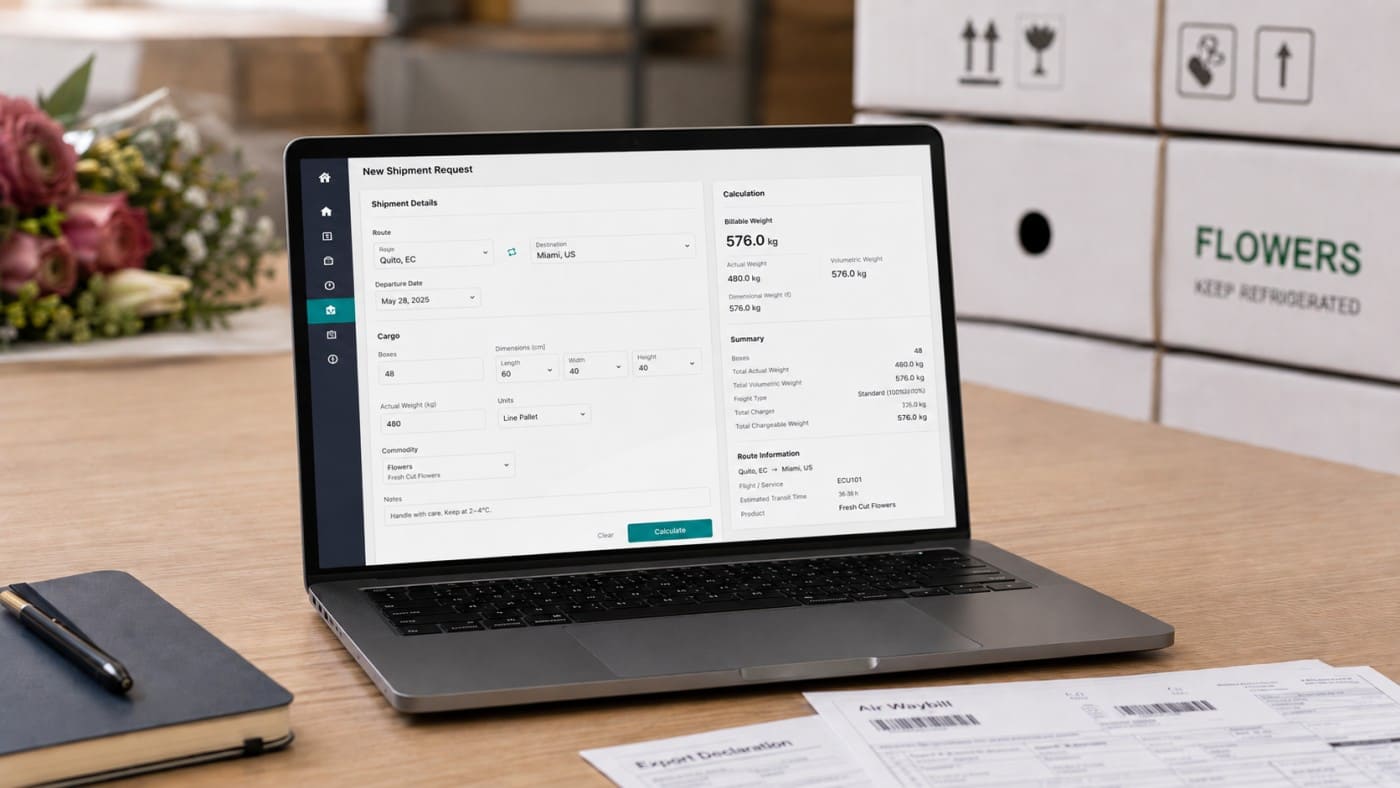
This is particularly vital for a flower shipment: long boxes, filler greens, mixed assortments, and palletization can significantly alter the chargeable weight. The more accurately a batch is described, the easier it is to compare shipping options based on both the rate per kilogram and the calculation base.
This approach does not override the carrier's tariff rules or guarantee the lowest cost. It helps avoid a different mistake — planning a shipment based on incomplete data when dimensions and packaging methods have not yet been factored in.
When Volumetric Weight Is Most Critical
Volumetric weight becomes critical when space constraints outweigh mass constraints. In flower logistics, this often occurs not due to excess packaging, but due to the very nature of the cargo: long stems, bulky greens, protective clearances, and palletization. Therefore, when comparing routes, it is vital to evaluate shipment dimensions in advance, rather than just the mass of the boxes.
Volumetric weight should be calculated with particular care in the following cases:
- filler greens and filler flowers occupy a large volume with a light mass;
- long-stemmed flowers require elongated boxes;
- long boxes sharply increase volumetric weight even with moderate loading;
- small shipments are sensitive to every extra box;
- urgent air freight leaves less time for repacking and packaging adjustments;
- long-haul routes amplify the impact of logistics on shipment profitability;
- mixed shipments are harder to predict in terms of density;
- palletization shifts the calculation from the box level to the cargo unit level;
- preliminary profitability calculations require an accurate chargeable weight;
- comparing multiple routes without dimensions provides an incomplete cost picture.
Pre-Shipping Checklist for Flower Air Freight
Before calculating flower air freight, you must gather not only the weight but also the packaging parameters. Otherwise, the preliminary cost will be built on an incomplete base. The checklist should be reviewed before submitting a booking, especially if the shipment is mixed, palletized, or requires thermal insulation.
- precise box dimensions are known;
- the actual weight of the boxes or the entire shipment is known;
- volumetric weight is calculated;
- the estimated chargeable weight is determined;
- the conversion factor is verified with the carrier or within the chosen calculation terms;
- the pallet is accounted for if the shipment is built up as a cargo unit;
- insulation, stretch film, overpacking, and protective elements are accounted for;
- the flower variety, stem length, and packing density are factored in;
- offers are compared under identical conditions: weight, dimensions, route, transport scheme, handling;
- packaging does not compromise flower quality for the sake of volume reduction.
If some of this data is unknown, the calculation should be treated as preliminary. For an importer or wholesale buyer, this is a signal: the budget is not yet locked in, and the final shipping cost may change once the batch parameters are clarified.
FAQ
What is volumetric weight in flower air freight?
Volumetric weight is a calculated weight based on box dimensions. It indicates how much space a shipment occupies in the aircraft. For flowers, this is particularly noticeable: long stems, filler greens, protective packaging, and empty space inside the container increase volume even with a low actual mass.
How does volumetric weight differ from actual weight?
Actual weight represents the physical mass of the cargo on the scale. Volumetric weight represents the space occupied by the packaging. A box of flowers might weigh 12 kg but yield 20 kg of volumetric weight based on its dimensions. In such cases, the freight calculation may not be based on the actual mass.
What is chargeable weight?
Chargeable weight is the metric used to calculate the cost of transportation. It is usually the higher value between the actual weight and the volumetric weight. If a shipment's actual weight is 120 kg and its volumetric weight is 200 kg, the rate per kilogram may be applied to 200 kg.
How do you calculate volumetric weight for air freight?
For air cargo, the formula often used is: Length × Width × Height / 6000, when dimensions are in centimeters. The result is in kilograms. The specific factor must be checked against the carrier's terms, route, transport scheme, or tariff rules.
Why can flowers cost more to ship than they seem to by weight?
Long stems, filler greens, buds, and protective packaging occupy space in the aircraft's cargo hold. If the volumetric weight exceeds the actual weight, air freight costs may be calculated based on the volumetric metric rather than the box mass on the scale.
Can volumetric weight be reduced through tighter packing?
Sometimes packaging can be optimized: selecting boxes more precisely, eliminating excess voids, or segregating the shipment by packaging types. However, excessively tight packing is hazardous for flowers. It can damage buds, stems, and filler greens, degrade ventilation, and diminish the shipment's merchantable quality.
Why might a preliminary calculation differ from the final invoice?
At the terminal, the cargo can be remeasured, reweighed, overpacked, insulated, or built up on a pallet. This changes the dimensions, actual weight, or the outer contour of the cargo unit. If the new volumetric weight is higher than the original estimate, the chargeable weight and the final transportation cost may increase as well.
