
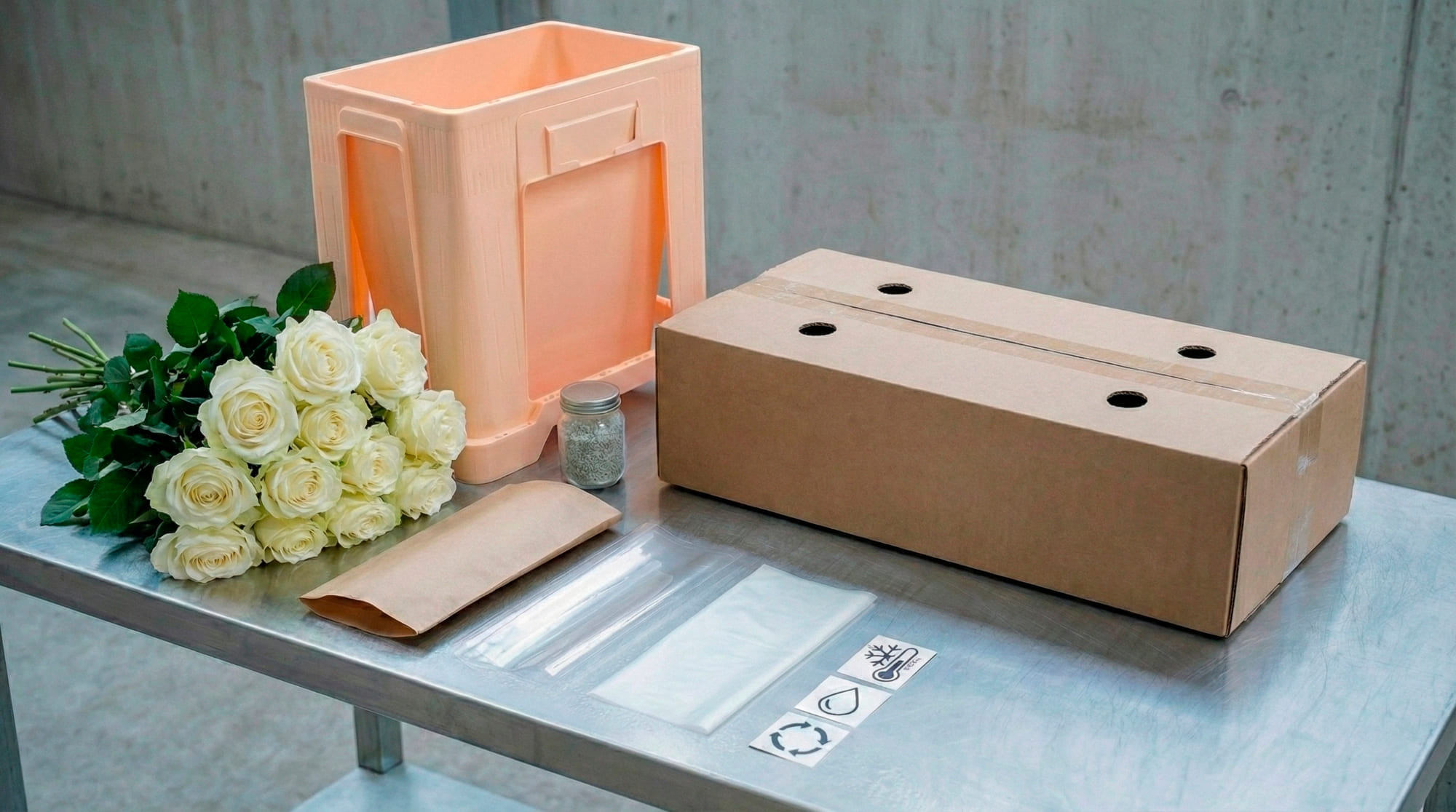
In brief: what is actually happening in the market
Why packaging has become strategic: quality, cost base, and waste
In the flower business, packaging stopped being just a “pretty wrap” a long time ago. It helps preserve product presentation at every step of the chain: it reduces friction and crushing during boxed transport, holds the bunch shape, affects humidity and condensation around the bud, and helps during the transition from a cold room to a warm environment. That is why any material change quickly shows up in losses and returns, not only in the perceived “eco-friendliness.”
A quick note on terms to avoid confusion later: flower sleeves are the outer paper or film wrap around a bouquet or bunch that protects it and shapes its presentation.
In parallel, packaging has become a cost component that is now assessed more broadly than the “price per sleeve.” In practice, companies account for:
- direct costs (packaging procurement, assembly waste),
- quality losses (damage at receiving, write-offs, returns),
- operational effects (assembly speed, packaging batch consistency),
- the fate of waste in target regions (whether recycling or industrial composting streams exist).
Because of this, the market increasingly relies on life-cycle comparisons and use-case scenarios rather than a “bio” label: LCA (life cycle assessment) helps compare packaging by its total impact across the full path — production → use → disposal/recycling. A good example of this scenario-based comparison for flower and plant sleeves is Royal FloraHolland / Partners for Innovation LCA study.
Three drivers of change: regulation, retail, and customer expectations
1) Regulation and industry commitments
Retail chains and brands in the UK publicly commit to targets that also affect the flower category. The “UK Plastics Pact Roadmap to 2025” sets the direction for shifting plastic packaging toward solutions suitable for reuse, recycling, or composting by 2025.
In parallel, within the flower value chain there is an industry driver: the Floriculture Sustainability Initiative (FSI 2025). The key point is that this is not “one material replacing another,” but shared sustainability rules across the chain — with three focus areas and measurable targets, including reducing the product carbon footprint (PCF) and transparent reporting, including due diligence.
EU regulatory framework (PPWR) — to understand the deadlines. The Packaging and Packaging Waste Regulation (PPWR) entered into force on 11 February 2025 and will start to apply generally from 12 August 2026. From there it sets a clear trajectory for the market: packaging must be designed to be recyclable by 2030; plastic packaging faces a stronger focus on increasing recycled content, and restrictions are introduced for certain formats of single-use plastic packaging. For the flower business, this matters not as a “legal reference,” but as an explanation of why retailers and suppliers are accelerating: changes in materials and designs will need to be validated in advance — before the application date — otherwise there is a risk of running into updated specifications and EPR logics for packaging.
2) Retail pressure for fast, verifiable changes
Retailers often start with the most visible and most common item — flower sleeves (display wrap). This is a typical pattern: plastic is removed first where the effect is visible to customers and where quality impacts are easier to control.
3) Customer expectations and demand for clear sustainability signals
Packaging is one of the first “sustainability” markers in the eyes of the audience, but this does not отменяет the baseline requirement for freshness. Consumer preferences overview: https://sustainabloom.org/industry-guide/consumer-preferences.
Materials from the Floral Marketing Fund add data on attitudes and willingness to pay (with caveats on methodology and segments).
The practical takeaway for business is straightforward: packaging can support trust, but quality losses almost always “erase” that effect faster.
Below is a condensed map of how the three drivers are typically translated into practice.
| Driver | What changes in requirements | Where change most often starts |
| Industry commitments/targets | “recyclable / reusable / compostable where facilities exist” wording, bans on certain formats | Retail specifications, tenders, reporting |
| Retail | Replacing plastic in visible elements, reducing “extra layers” | Sleeves/wrap, branded elements |
| Customers | Demand for understandable materials and honest wording | Paper, minimising plastic on display |
Core idea: the market is not moving “to bio,” but to a mix of solutions
Real cases and industry documents show that no single material can cover display, delivery, wholesale, and international long-haul legs with transfers at the same time. As a result, a set of approaches is forming, where each one addresses its own task
- Paper often covers display and part of logistics, especially where regional paper-waste streams are well established.
- Compostable materials appear selectively, and their value depends on infrastructure. As a reference for raw materials and formats, the NatureFlex family of cellulose films is often cited NatureFlex.
- Where composting is not available but PP/PE is actually accepted for recycling, the most practical step is switching to single-polymer packaging (mono-material). This is how Broekhof frames it: their Recy® sleeves are made from mono-material PP, which is easier to recycle, although recycling availability depends on the region.
- PCR and circular models develop in parallel as a way to reduce the share of virgin material, but the outcome depends on collection and recycling quality.
- Reusable transport packaging shows the strongest effect in B2B chains where return points exist. For a general understanding of the logic and formats, you can rely on Royal FloraHolland materials on sustainable packaging.
The key practical thesis for the entire article is that environmental impact and quality losses are directly linked. If new packaging leads to more damage or faster wilting, the losses from write-offs can easily outweigh any material benefits.
Why the industry is choosing a mix, not one material “for everything”
Paper: clear end-of-life and mass adoption in retail
Paper gained momentum because, for customers and many municipal waste systems, it is easier to understand than a “new bio-material.” In flowers, this is primarily sleeves and wrap.
At the same time, in flowers paper almost always depends on conditions:
- moisture and condensation (cold-to-warm transitions),
- strength and shape retention (crushing in boxes and during transfers),
- coatings (moisture resistance can reduce recyclability — this must be checked for the specific paper and local waste streams).
Compostable solutions: targeted use and dependence on infrastructure
Compostable formats in flowers are more common where “transparency” or moisture protection is necessary and the goal is to move away from conventional plastic. A typical class of such materials is cellulose films positioned as compostable.
But without industrial composting infrastructure, the real waste pathway often does not match expectations: a material may be marketed as compostable, yet in practice goes into mixed waste or to landfill. This is discussed in detail in the University of Surrey academic review on plastics, packaging, and waste in floriculture.
A separate niche is hydration components, where paper often cannot meet the requirement. An example of a commercial product with claimed compostable hydration is the Menagerie hydration wrap — a hydration set for transporting/delivering cut flowers (absorbent wrap + compostable bag + rubber bands) that keeps stems moist without leaks and even allows a bouquet to be transported horizontally.
Data limitation: the product page does not always show which standards the compostability claim is based on and under what conditions it is validated; this should be clarified via the material specification and certificates.
Recycling and mono-material: a practical transition scenario
Where industrial composting is not available but PP/PE collection and recycling are established, the market more often chooses a simplified packaging design: one material instead of multi-layer combinations, fewer coatings and layers, clear labelling.
The practical meaning for the flower business is this: single-material packaging is usually easier to keep consistent from batch to batch and can behave more predictably in the cold chain on long-haul legs, but the environmental benefit depends on whether it enters a real collection and recycling stream in a given country or city.
PCR and circular models: what delivers impact and where the limits are
PCR (post-consumer recycled) is feedstock made from post-consumer waste. In flower sleeves and films, PCR enables reducing virgin plastic content without a radical change in material behaviour in logistics. Product example: Paardekooper PCR sleeves.
News overview of sleeves made from plastic waste: https://aiph.org/floraculture/news/broekhof-launches-flower-sleeve-made-from-plastic-waste/.
The limitation needs to be stated clearly: PCR is still plastic. The environmental benefit depends on collection/sorting/recycling quality and on the product not turning into a multi-layer composite that then is not recycled. This is why the topic of layers, printing, and coatings keeps coming up in industry publications.
Reusable transport packaging: a separate sustainability track in B2B logistics
Reusable formats show the strongest effect where regular supply and return points exist: auctions, hubs, distribution centres. In flowers, these are returnable buckets/containers/standardised transport units. Royal FloraHolland systematically covers sustainable packaging and reusable formats, and you can review their materials on their website:
- general section: https://www.royalfloraholland.com/en/sustainable-packaging
- reusable transport packaging range: https://www.royalfloraholland.com/en/sustainable-packaging/assortiment-meermalig-bloemenfust
- news about the new Fc555 bucket (2025): https://www.royalfloraholland.com/en/news-2025/week-21/new-flower-bucket-fc555-preserves-floriculture-and-increase-efficiency
A constraint you cannot ignore: reuse only works with disciplined return logistics. If returns are not organised, “reusable transport packaging” quickly becomes inventory loss and additional replacement costs.
How to distinguish real implementation from marketing
What a practical case looks like: what was replaced, with what, and under what conditions
It is easy to drown in statements like “eco,” “bio,” “sustainable.” For an analytical article, only cases are valuable where it is clear what was replaced, with what, where it works, and what the constraints are.
A minimum set of indicators that make a case practical:
- Specificity about what was replaced. Not “we reduced plastic,” but “plastic sleeves for bouquets were replaced with paper wrap.”
- The material and design are named explicitly. “Paper,” “cellulose film,” “mono-material PP/PE,” “a sleeve with a PCR share.” If it only says “eco-friendly film,” that is not a material, it is a slogan.
- A scope of applicability is stated. Display, delivery, wholesale, air freight, hubs, last mile — if the author does not say where it was tested, it is almost always a local experience without transferability. A good example describing a specific format and campaign context is Waitrose “wrap-free” (UK, 2022).
- At least a period/year of implementation is given. This matters because requirements and materials change quickly, and “when” affects interpretation.
A practical caveat for the reader: even with a well-described case, you cannot automatically переносить it to another market. The reason is almost always the same — different end-of-life and different logistics (haul length, transfers, temperature regime). That is why the article continues with the logic: case → conditions → what to clarify in your own chain.
Primary sources: reports, specifications, LCA, industry guides
The most credible claims are those that leave a “trace” in primary documents. In this area, there are typically four types of sources.
-
A company sustainability section / official packaging policy. For example, Bloom & Wild’s delivery packaging description (UK): packaging page.
Pros: an official source. Cons: wording is often high level, and material details must be verified in specifications. - LCA and scenario-based comparisons. For flower packaging, LCA (life cycle assessment) is useful because it compares solutions not by an “eco label,” but by total impact across the full path — from production to disposal/recycling — and within specific use scenarios. Example: the Royal FloraHolland / Partners for Innovation LCA overview for sleeves.
- Industry and academic reviews on waste and packaging. They provide language, typical mistakes, and accurate phrasing for claims. If you keep one source that covers the topic systematically, it is reasonable to cite the University of Surrey academic review discussed above.
- Specifications and materials from raw material/packaging suppliers. They are useful as a source on material properties, but they cannot be read as a “guarantee of performance in logistics,” because the supplier describes the material under test conditions. Examples:
Observation: the closer a source is to operational reality (LCA, specification, packaging report with conditions of applicability), the less room there is for marketing.
Red flags: “biodegradable” without an answer on where and how it is disposed of
The term “biodegradable” on its own says very little about what will happen to packaging after use. In practice, it is a warning sign if:
- the conditions under which the material breaks down are not specified (industrial composting, home composting, soil, marine environment — these are different regimes);
- there is no clear wording such as “compostable in industrial facilities” or “recyclable where facilities exist”;
- it is not explained what happens in the countries and cities where the product is sold: whether separate collection exists, composting is available, or recyclers accept the material.
The criterion is simple: if a material is labelled “bio,” but the description does not answer the question “where does this go after sale, and what is actually done with it there,” you cannot claim a verified environmental benefit.
Terms without confusion: biodegradable, compostable, recyclable, reusable
Biodegradable ≠ compostable: what matters in real end-of-life
Biodegradable describes material breakdown under the action of microorganisms under certain conditions. Without specifying conditions, the term does not describe a real outcome.
Compostable is more practical because it implies a managed process, but it also requires clarification: where exactly composting takes place.
Why this matters for flowers: the same film can be “biodegradable” in laboratory conditions, yet in the real waste stream it ends up in mixed waste and does not deliver the claimed effect.
Industrial composting vs home composting: why this changes the meaning of packaging
Industrial composting is a controlled regime (temperature, humidity, aeration, turning) in which compostable materials break down within timeframes defined by the standard. Home composting is composting in domestic conditions: the regime is usually irregular and often “cold,” so timelines and outcomes are not guaranteed.
The takeaway for the flower business is straightforward: packaging may be labelled as compostable, but if industrial infrastructure is not available in the destination cities and countries, it will almost certainly end up in general waste. That is why specifications should state composting conditions (where and under what regime), rather than relying on the “compostable” label alone.
Limitation: public supplier materials do not always show which standards and conditions are validated — this must be checked in specifications and material certificates.
Recycling and mono-material: when this is more sustainable than “bio”
Recycling can provide a clearer environmental benefit than compostability if three conditions are met at the same time:
- collection and recycling of the required material (PP/PE) are actually in place in the region;
- the product is made from a single polymer (mono-material), without layers, laminations, or “assembled” constructions;
- labelling and sorting are not undermined by coatings, dense printing, adhesives, and other additives.
In floriculture this is especially critical for sleeves and films: multi-layer solutions and coatings often push packaging into the “theoretically recyclable” category, but in practice it fails sorting or is not accepted by recyclers. That is why suppliers increasingly promote mono-material and recycling as the most workable route where infrastructure actually exists.
The broader context on what specifically disrupts recycling in floristry is compiled in an industry guide: https://www.sustainablefloristry.org/ppw-guide/
PCR: what it is and why it is still plastic
PCR (post-consumer recycled) is secondary feedstock made from “post-consumer” waste: materials that have already been used, collected, and recycled back into pellets/feedstock.
In flower packaging, PCR is most often used in sleeves and films: plastic remains plastic, but the share of virgin material is reduced.
It is important to state the limitation clearly: PCR does not solve the waste problem on its own. The effect depends on how well collection and recycling work, and on whether the product remains suitable for further recycling (without multi-layer structures and heavy coatings). That is why industry documents regularly cite mixed materials as a baseline problem.
Where most plastic forms in the flower supply chain
Sleeves and films: display, assembly, transport
The most visible source of plastic is sleeves and films around bouquets and bunches. Their lifecycle is short: display → purchase → waste. That is why retail often starts here, achieving a measurable effect in the category.
At the same time, a sleeve is not a neutral component. It reduces friction, helps hold shape, and lowers the risk of mechanical defects. That is why, when changing materials, it is critical to look at moisture and condensation: sealed film and paper behave differently.
Hydration and stem protection: water packs, inserts, vials
The second major area is components that retain moisture: water packs, inserts, vials. By weight they may be small, but by unit count they are high-volume. Paper does not always meet the moisture-retention requirement, so niche compostable solutions appear more often here.
Limitation: for a proper assessment, you need data on the compostability standard and on where exactly such material is disposed of in the target regions.
Transport packaging and securing: buckets, trays, boxes, stretch wrap
In B2B chains, plastic is often “hidden” in transport units and securing materials: buckets, trays, stretch wrap, strapping. The key difference versus sleeves is that some transport units circulate and have a long service life, so reuse delivers a strong effect when returns are disciplined.
Décor and consumables: ribbons, fasteners, foams
Small consumables often create a “tail” of waste and at the same time complicate sorting because they mix materials and add small plastic components. In volume this may be less than sleeves, but the impact on recyclability is noticeable.
Materials and solutions that are actually replacing plastic
Paper sleeves and moisture-resistant paper: benefits, drawbacks, constraints
Paper most often appears where display and a clear end-of-life pathway matter, and where the logistics leg is not heavily stressed by moisture and transfers. At retail level, this is no longer an experiment but an established practice.
What paper delivers in practical scenarios:
- A clear waste pathway where paper is actually collected and recycled.
- A visually “light” format without the feel of unnecessary plastic, aligning with the expectations of some customers — reflected in the Sustainabloom consumer preferences overview..
- In some LCA scenarios, paper sleeves show comparable or lower footprint, but only with correct assumptions about end-of-life and quality losses.
Constraints that show up quickly in flowers:
- Moisture and condensation. Standard paper loses shape under high humidity and temperature swings. In retail this is often mitigated via moisture-resistant paper, but then coatings and recyclability become critical: coatings can reduce recyclability, and this must be confirmed for the specific product and local waste streams.
- Mechanics and shape retention. On long-haul legs and with dense packing, paper creases faster, which can increase defects from friction/compression.
- Price and batch consistency. Practical rollouts often note higher cost and the need for batch control.
What must be validated in practice (and the article will return to this as a general principle): how paper behaves when moving from cold storage into a warm zone, how quickly it loses shape during humid assembly, and whether a coating creates a “barrier” that undermines recycling in the target regions.
Cellulose and compostable films: where they make sense and where they do not
Cellulose films and compostable formats appear more often where a transparent sleeve or moisture protection is needed, but the goal is to move away from conventional plastic.
Where such materials are typically justified:
- Transparency is needed (visibility of the bouquet/variety/brand), and paper does not meet the requirement.
- There is at least a basic understanding of what happens to waste after sale: whether industrial composting exists in the target cities, how organics collection works, and what the operator accepts.
Where the gap between claim and impact most often appears:
- No industrial composting. In that case, compostability remains a property “in the right environment,” while the actual pathway is mixed waste.
- Temperature/moisture transitions. The behaviour of compostable films may differ from familiar PP/PE. Without testing on a specific route, there is a risk of more condensation or more contact damage.
- Packaging claims. If there is no precise statement of where the material is composted (industrial or home), the claim is not sufficient for decision-making.
Data limitation: public supplier pages often do not make it clear which compostability standards apply and under what conditions the material must break down. For operational adoption, you need specifications and validation; otherwise, it remains a marketing promise.
Bioplastics (PLA and others): temperature, moisture, and composting conditions
In flowers, PLA and other bioplastics are often discussed as a “green substitute.” In real supply chains, the value of bioplastics is determined by two factors: the logistics regime and disposal infrastructure.
Key links to conditions:
- Disposal. This often refers to industrial composting. If such infrastructure is not available in the target sales regions, the material does not follow the claimed end-of-life scenario.
- Temperature and moisture. In flowers, cold-to-warm transitions and condensation are critical. If the material amplifies a “greenhouse effect” or tolerates swings worse, quality losses will exceed any material-related benefit.
- Mixing waste streams. Bioplastic that ends up in the wrong stream (for example, in plastic recycling where it is not accepted) can degrade sorting.
The limitation must be stated clearly: if a material description does not clearly answer where it is composted and how it is separated from other streams, it is not a basis for claims of environmental benefit.
PCR and mono-material: a “transition” scenario when composting is not available
PCR and mono-material are often chosen not for ideological reasons, but because they are easier to link to existing recycling systems while keeping packaging behaviour familiar within the cold chain.
PCR as a practical option
PCR in sleeves and films reduces the share of virgin plastic without a sharp change in material properties in logistics.
Limitation: public descriptions usually do not show the PCR percentage, sorting requirements, or how the packaging behaves in real end-of-life systems across different countries. For implementation, you need a specification and a clear disposal scenario for your markets.
Mono-material and recycling as a direction
The mono-material logic is to remove material combinations and unnecessary layers to increase the chance that packaging enters a real recycling stream and to make quality more consistent from batch to batch. But the environmental benefit still depends on infrastructure: if collection and recycling do not work, a “right” construction does not guarantee an outcome.
Strengths of the PCR/mono-material scenario
- more predictable logistics performance compared with many “bio” alternatives;
- a clearer end-of-life pathway where PP/PE is actually collected and recycled;
- a reduced share of virgin feedstock through PCR without radically changing materials and processes.
Weak points that cannot be glossed over
- PCR is still plastic, and the impact depends on collection, sorting, and recycling quality;
- layers, coatings, dense printing, and adhesives often make a product “recyclable on paper” but effectively non-recyclable;
- press releases and product pages without specifications do not allow you to conclude whether the solution will work on a specific route and within a specific end-of-life system.
Reusable transport packaging and return systems: where the impact is highest
Reuse delivers the greatest effect in B2B chains where there are clear return points and regular circulation: hubs, auctions, distribution centres, large wholesale platforms. Here, packaging stops being a consumable and becomes part of infrastructure.
Where the impact is highest:
- regular deliveries with return schedules for packaging;
- centralisation at nodes where collection, sorting, and washing can be organised;
- standardised sizes to reduce damage and speed up handling.
Core limitation: without return discipline, reusable packaging creates financial losses and quickly turns into continuous replacement purchases.
What the research base and industry reports say
Demand and customer expectations: what actually matters to the audience
Two consistent conclusions recur across industry materials: packaging is one of the first markers of “sustainability” in customer perception; willingness to pay more for more sustainable packaging exists, but it depends on trust and on a clear answer to “what exactly was improved.”
A useful clarification from an audit of real retail packaging for cut flowers in the US (Gillespie, 2025): customers often cannot tell what the packaging is made of or where to take it because there is no labelling. In a sample of 35 items, 82% had no material identification, and the formats varied widely (OPP, HDPE, paper, PET, and nonwoven PP). This directly explains why “willingness to support sustainable packaging” runs into the need for transparent claims and a clear post-use scenario on the packaging itself. Source: https://open.clemson.edu/all_theses/4516/
A limitation that must be kept: even with a positive attitude toward reducing plastic in floriculture, the decisive condition is quality. Returns driven by freshness losses typically hit margin faster than any benefit from the “right” label.
LCA logic: why materials are compared through the lifecycle
LCA (life cycle assessment) is useful because it moves the conversation from “seems more sustainable” to a scenario-based comparison you can test: feedstock and production, transport, and—most importantly—what happens after use (collection, sorting, recycling/incineration) and which assumptions are built into the calculation.
For packaging sleeves this is especially important: the visible “effect” (for example, paper instead of film) does not answer the question of total impact by itself. The correct question is: “in which scenario does this material deliver the better outcome—taking into account real end-of-life and whether the sleeve actually reaches recycling.” In the Royal FloraHolland / Partners for Innovation LCA quick-scan, paper sleeves (especially those made from 100% recycled fibre) show the lowest CO₂ impact; among plastic options, PP and LDPE results are close, and the end-of-life scenario has a strong influence on the outcome (sorting and actual recycling deliver a meaningful gain).
Research limitations: why findings cannot be applied to any route
Even high-quality reports and LCAs have limitations that are particularly visible in flowers:
- End-of-life depends on the region. The same material may go to recycling, general waste, or composting in different countries (if composting exists at all). This is especially critical for compostable materials and bioplastics.
- The route changes requirements. What works in short retail distribution can fail in long-haul logistics with transfers and temperature transitions.
- Assembly and storage often matter more than “passport” properties. Warehouse humidity, packing density, and assembly speed often determine the outcome more than what is written in a material description.
A practical nuance: if packaging is broadly unlabeled, even the “right” material may not deliver an effect—customers and sorting systems simply do not know where to place it. In Gillespie (2025), this is highlighted as a systemic problem: in the sample of 35 items, 82% lacked material labelling; the author also emphasises the need to identify materials and, where possible, route packaging into available return/collection channels (including in-store drop-off for HDPE where such points exist).
Real implementation cases: who switched and to what exactly
Retail: replacing plastic sleeves with paper
Morrisons (United Kingdom)
- What was replaced: plastic sleeves/wrap for bouquets
- With what: paper wrap
- Period: announced in 2018
- Source: https://www.thegrocer.co.uk/news/morrisons-ditches-plastic-from-flower-bouquets-for-paper-wrap/571070.article
Limitation: the news item does not allow you to determine which coatings were used and how that affects recycling in different regions; these details must be checked in supplier specifications and local waste streams.
Consumables manufacturer: paper sachets + end-of-life labelling
FloraLife (Smithers-Oasis, global)
- What changed: packaging for flower food sachets/packets
- With what: recyclable paper sachets, stated as carbon neutral
- Period: announced in February 2023
- Source: https://floralife.com/2023/02/21/floralife-assesses-recyclable-paper-packets-line-and-announces-it-carbon-neutral/
What matters in the approach: the company explicitly notes that it first assessed the packaging footprint, then reduced it by switching to paper, and offset the remainder through an offsets partner. The practical point for the industry is that they added carbon neutrality marks and end-of-life guidance on the packaging itself—making the change verifiable and understandable for the end user/sales channel (not only “we became more sustainable,” but “what exactly changed and how to dispose of it”).
Retail: wrap-free approach and natural materials
Waitrose (United Kingdom)
- What changed: the standard bouquet wrap
- With what: a “wrap-free” format, a protective layer of natural leaves, and natural twine
- Period: 2022 (Mother’s Day campaign)
- Source: https://packagingscotland.com/2022/03/waitrose-launches-wrap-free-flower-bouquets/
Limitation: the format is tied to a retail sales scenario and a specific campaign; transferability to delivery and long-haul legs requires separate validation.
Delivery: packaging recyclable and compostable by component
Bloom & Wild (United Kingdom)
- What changed: the delivery packaging system (box and internal components)
- With what: components stated as recyclable or compostable
- Period: reflected in the company’s current sustainability section (without a single implementation year in the public wording)
- Source: https://www.bloomandwild.com/sustainability/packaging
Limitation: without specifications, you cannot conclude which compostability standards apply or in which regions these components actually enter the stated streams.
Producer: switching to paper sleeves in wholesale
Van Egmond Matricaria (the Netherlands)
- What was replaced: plastic sleeves for wholesale shipments
- With what: paper sleeves
- Period: published in 2023
- Source: https://www.floraldaily.com/article/9543076/van-egmond-matricaria-enthusiastic-about-paper-sleeves/
Limitation: this is an example of industry practice, not a universal standard; on other routes, humidity/handling transfers/packing density are critical.
PCR sleeves as a scalable compromise
Paardekooper (the Netherlands)
- What they are implementing/promoting: transparent Recy Clear sleeves made from recycled content (PCR) as an alternative to virgin-plastic sleeves; variants are stated as rOPP 70% PCR and rCPP 97% PCR
- Format: a PCR-sleeve product range for cut flowers
- Source: https://www.paardekooper.com/en_US/blog/item/recyr-clear-the-latest-generation-of-sustainable-flower-sleeves-301/
Broekhof (the Netherlands) — an industry overview
- What is covered: sleeves made from plastic waste as a direction
- Source: https://aiph.org/floraculture/news/broekhof-launches-flower-sleeve-made-from-plastic-waste/
Limitation: without specifications (PCR share, base material, recycling requirements), these materials cannot be tied to specific cold-chain conditions and local end-of-life systems.
Initiatives and pacts: how industry targets “pull” the flower category along
UK Plastics Pact (United Kingdom)
- What it sets: reference points for moving plastic packaging into formats suitable for reuse/recycling/composting by 2025
- Why it affects flowers: retailers and brands align categories with their overarching commitments
- Source: https://www.wrap.ngo/system/files/2024-07/UK%20Plastics%20Pact%20Refreshed%20Roadmap%20to%202025%20_0.pdf
Niche solutions: compostable hydration and accessories
Menagerie (United States)
- What it addresses: stem hydration and moisture retention
- Format: a hydration product described as eco-friendly/compostable
- Source: https://menagerieflower.com/products/eco-friendly-fresh-flower-hydration-wrap
Limitation: for a robust assessment, you need compostability evidence (standards, conditions, certificates) and an understanding of where this material ends up after purchase in the target regions.
How packaging affects logistics and flower quality
Condensation and ventilation: why “breathable / not breathable” drives losses
In flower packaging, a microclimate almost always forms. The main risk is not “cold,” but water in the wrong form: condensation on petals and leaves, a humid environment without air exchange, wet contact zones. The typical chain then follows: wet leaf → scuffing/spots → fungal risk → accelerated decline in marketable appearance.
What contributes to condensation:
- temperature swings (cold → warm zone during handling → cold again);
- material tightness (film more often creates a “greenhouse effect”);
- packing density (less air means a higher risk of reaching the dew point inside the sleeve);
- wet hydration elements if they touch foliage and packaging.
A pragmatic detail: paper sleeves and films behave differently. Paper more often “absorbs” some moisture and reduces fogging, but it loses shape faster and can tear at high humidity. This is why moisture-resistant paper formats are used in retail rather than standard paper.
A quick diagnostic marker after transit: if you see a lot of “wet leaf” and fogged areas around the bouquet head, the root cause is usually the combination of packaging material + temperature windows + ventilation.
Moisture, temperature, mechanics: what is critical on long-haul legs
On long-haul legs, packaging faces three loads at once, and each affects quality.
-
Moisture and stem hydration.
If the stem loses water, a sleeve alone will not compensate for the loss. At the same time, hydration elements add moisture around foliage and the packaging itself, increasing condensation risk. Compostable hydration options exist on the market, but you cannot draw hard conclusions without standards/certificates and a clear disposal scenario in the destination countries and cities (commercial example: https://menagerieflower.com/products/eco-friendly-fresh-flower-hydration-wrap). -
Temperature windows.
The risk is not stable cold, but a “sawtooth” profile: the shipment cools down and then warms up again. This raises the likelihood of reaching the dew point inside the sleeve and makes petals more sensitive to contact with packaging. Operationally, this is typically the “transfer — waiting — documentation” zone rather than the transport leg itself. -
Mechanics: not impact, but friction and compression.
On long-haul legs, the critical issue is not one-off impacts but continuous friction and crushing in cartons under dense packing. Paper can look advantageous on the shelf, but in dense outer packaging it creases more easily. Film holds shape better, but with temperature “windows” it more often leads to fogging. A practical observation on switching to paper with notes on quality and costs: Van Egmond Matricaria (the Netherlands, 2023).
Takeaway for the materials section: the same sleeve format cannot be applied “everywhere” without validation under the specific logistics conditions and packing configuration.
Cold chain compatibility: air freight, hubs, last mile
From a cold-chain perspective, packaging is a factor in controllability of the regime, not a decorative detail. The highest-risk zones are:
- Air freight. Dense loading, possible delays, then an abrupt shift into a warmer environment on the ground. During these transitions, packaging often becomes a condensation trigger.
- Hubs and transfers. This is where temperature “windows” and mechanical loads most often occur. It is also where material weaknesses show up: paper creasing, fogging in tighter films, and inconsistent behaviour of moisture-resistant paper coatings.
- Last mile. A fast exit from cold storage and delivery “in warmth” is a typical trigger for fogging. In retail and delivery, this zone affects returns and complaints more than the transit itself.
Loss economics: when “more expensive packaging” makes the “total outcome cheaper”
In flowers, packaging is often assessed by unit price. For quality and logistics, it is more accurate to calculate the cost of losses. This becomes especially visible when sleeve material or packing format changes.
Typical loss items to keep alongside the packaging price:
- returns due to appearance (creased, wet, petal damage);
- shrink on the shelf (reduced selling time);
- defects at receiving (friction, breaks, crushing);
- reputational losses in delivery (complaints, resends).
For “paper vs film,” the balance often shifts on long-haul legs and in the last mile, which is why scenario comparisons and LCA are increasingly used as a framework to discuss chain-level impact rather than “by feel.”
Risks and common mistakes when switching to sustainable packaging
“Eco” without end-of-life infrastructure: what it turns into in practice
The most common failure is to claim compostability or biodegradability where there is no corresponding waste stream. The outcome is almost always the same: the packaging goes into mixed waste, and the claimed environmental effect cannot be verified.
A practical criterion: if a material is marketed as compostable but there is no answer to “industrial or home,” and no understanding of availability in target sales cities, the claim remains incomplete.
Mixed materials and printing: what breaks recycling
The second typical mistake is packaging that looks “recyclable” but in practice does not reach recycling because it is hard to sort or recyclers do not accept it. Most often, the blockers are:
- multi-layer “sandwiches” (paper + film + adhesive);
- barrier coatings and lamination;
- dense printing, varnishes, and adhesive layers;
- lack of clear material labelling.
This is why the market is increasingly moving toward mono-material and simpler constructions: where it is clear what the item is made of and where it should go after use. Packaging suppliers typically frame this through a focus on recycling and material choices.
No tests and no SOPs: why quality “drifts” after two weeks
Packaging changes are often made “by feel” and based on the first few days. After 1–2 weeks, complaints start coming in and defect rates rise because:
- packaging storage turned out to be humid (paper and sleeves lose shape even before assembly);
- assembly differs between shifts (tightening, sleeve length, petal contact with the edge);
- the packaging batch changes in thickness/coating, and this is not noticeable right away;
- the test did not include the real transport duration and the last mile.
Appearance over function: when packaging reduces freshness
Packaging can look “natural” and neat, but reduce freshness if it:
- increases condensation and wet leaf;
- reduces ventilation around the bouquet head;
- increases petal friction against the sleeve edge;
- loses shape and starts damaging the flower during packing.
What to check in packaging descriptions and supporting documents
Composition and evidence: material, certificates, stated end-of-life
For flower packaging, the “eco” label is not what matters—specifics on composition and evidence do.
What should be clear from the documents:
- exact composition and construction: single material or layers, whether there is lamination and adhesive layers;
- coatings: moisture resistance, barrier, “gloss,” and where exactly they are applied;
- stated end-of-life in a correct wording (for example, “recyclable where facilities exist” or “compostable in industrial facilities”).
Behaviour in real logistics: temperature, moisture, condensation
Material documents are useful, but in flowers the route scenario is what determines outcomes. In packaging descriptions, look for properties linked to losses:
- response to humidity and condensation (critical for paper and coatings);
- shape retention under compression and friction;
- ventilation characteristics (excessive tightness increases fogging risk);
- stability during cold/warm transitions.
Storage and assembly: what damages packaging before it reaches the shelf
Losses do not start only in transit. Common defect drivers are storage and assembly:
- storage in a high-humidity area (paper deforms, sleeves lose shape);
- temperature swings in storage;
- different assembly techniques across shifts (petal contact with the sleeve edge, excessive tightening, a sleeve that is too short);
- an unnoticed batch change in thickness/coating.
Outer packaging and packing pattern: where damage most often occurs
Even a good sleeve will not compensate for errors in outer packaging and packing patterns. Typical risk points:
- over-dense packing without separators: constant petal friction;
- compression in the carton: paper creases faster, film holds shape but increases condensation during temperature windows;
- handling transfers at hubs: short regime breaks plus mechanics quickly increase defect rates.
How validation is done in practice: test metrics and result capture
To compare materials without self-deception, companies track a set of metrics using the same method. A minimum set commonly used in operational practice:
Metrics checklist:
- defects at receiving: share of bunches/bouquets with damage (creased sleeves, tears, petal scuffing);
- condensation after leaving cold storage: wet leaf, fogging, moisture around the bud zone;
- shelf shrink: write-off share by SKU and time to loss of marketable appearance;
- delivery complaints/returns: split into “appearance” and “freshness”;
- operational indicators: assembly speed, packaging defects during assembly, packaging batch consistency.
How companies typically switch to new packaging without quality failures
Inventory: where plastic is truly needed, and where it is just habit
The initial mistake is to change the material “across the board.” A workable approach is to break packaging down by functions and chain stages, then decide where plastic is solving a real problem and where it has simply remained by inertia.
A practical map most teams start with:
- retail display and assembly: sleeves/wraps, pads, securing elements;
- hydration: water bags, inserts, vials;
- transport: buckets/trays/cartons, stretch wrap, strapping, separators.
If you capture “why it is needed” for each element at this step (mechanics/moisture/shape/labelling), it becomes easier to avoid substitutions that reduce freshness.
Here it helps to lean on an approach currently promoted by academics together with the industry: first identify hotspots—where along the chain plastic, packaging, and waste actually accumulate—and only then select alternatives and validate them “in real practice” (not by the material datasheet). In the Coventry University project this is framed as an industry problem: chain participants often lack information on where the biggest contribution sits, what alternatives exist, and how robust they are in practice—so the work starts with hotspot mapping and distributing solutions via a working group and a guidance booklet. This reinforces the inventory logic: we are not “looking for the most correct material,” we are finding points of maximum impact and managing them.
Mini inventory checklist (as a recording format):
Packaging element → function → where used (retail/delivery/wholesale/air) → contact with moisture/cold → end-of-life in target cities (known/unknown).
A quick 4R frame for decisions on each element
To keep the inventory from becoming just a list, it is useful to run each element through a simple 4R priority order (a logic widely used in industry guidance for wholesalers—see Sustainabloom — Plastics Guide for Floral Industry Wholesalers (PDF)):
- Reduce — can you reduce material/layers without risking quality and freshness?
- Reuse — can the element be moved to a returnable format (exchange/return/reuse)?
- Recycle — can you simplify the composition to mono-material and reach a real recycling stream in target cities?
- Replace — only if the first three steps do not deliver: what can you replace the material with without increasing quality losses?
In wholesaler guidance, this is described through practical examples: for instance, instead of repeatedly swapping sleeves (“plastic to plastic”), they suggest reducing plastic use and switching to paper where it can even improve quality due to less free moisture, and using returnable containers to full end-of-life (bucket exchange).
A pilot on a limited assortment: 1–2 items and a baseline for comparison
A pilot should almost always be narrow. Not because it is “safer” in an abstract sense, but because otherwise you cannot identify what is actually causing changes in quality.
A workable format:
- 1–2 items that provide enough repetitions in volume;
- a fixed baseline packaging “as was” and a test version “as becomes”;
- the same flower lot and the same logistics, as far as possible.
If the pilot includes delivery, you cannot evaluate it based on retail display conditions. The reason is condensation and the transition out of cold storage, which will only be visible on a real route.
Assembly and storage SOP: so results don’t depend on the shift
After the first days, when “everything seems fine,” quality often starts to drift not because of the material itself, but because of the process. With sustainable packaging this shows up more strongly, because paper and coatings are sensitive to humidity and to assembly technique.
What is typically fixed in the SOP:
- packaging storage: a dry place, humidity control, protection from temperature swings;
- assembly: where the sleeve must have clearance, where tightening is acceptable, which edges must not touch the petals;
- batches: how to track thickness/coating/supply changes (the SKU may be the same while properties differ);
- labelling and end-of-life: which claims are acceptable on the label and what to tell the customer without making promises.
Validation in motion: route, transfers, last mile
Another common mistake is to test new packaging only in calm conditions. In flowers, the “quality gap” most often appears at stages with temperature windows and mechanical stress.
A minimum set of scenarios that provides a useful picture:
- one route with a transfer/hub (if it is typical for your chain);
- one last-mile scenario (cold → warm environment → handover);
- one storage-before-sale scenario (retail display or warehouse).
Scaling: when to roll out across the assortment and what to revisit
Scaling only makes sense after results are stable not for “a few days,” but over a window where shifts, different batches, and different weather conditions show up. In practice, teams often use a period long enough to see repeatability of defects and returns against the same metrics.
What is typically revisited before expansion:
- supplier and batch consistency (this matters more than a nice material description);
- sleeve/wrap design (thickness, coating type, ventilation elements, size);
- outer packaging and packing pattern (some defects originate not in the sleeve, but in the carton and on the pallet);
- end-of-life wording (remove claims without conditions).
Conclusion
The shift to sustainable packaging has moved beyond image and become an engineering task. The market is moving away from simple answers (“switch everything to paper”) toward a scenario-based approach, where materials are chosen for a specific route and local infrastructure.
To ensure that implementing new packaging delivers real impact rather than losses, the industry is converging on three basic principles:
- Logistics dictates the material. Moisture, temperature windows, and transfer mechanics are hard constraints. Packaging must withstand the real route, not just look good on the shelf.
- Verifiability over slogans. Without real recycling or composting infrastructure in the target region, an “eco” label is meaningless.
- The economics of losses. Flowers written off due to condensation or crushing will always cost more than any savings on the sleeve itself.
Implementing this approach requires precision in communication between the buyer, the logistics team, and the supplier. It is not enough to choose the “right” material—you need to define the conditions under which it will perform across the entire supply chain. In this context, platforms such as Cargo Flowers become a necessary connecting link: they make it possible to translate abstract sustainability and quality requirements into a set of concrete, agreed transport parameters. Only this makes it possible to ensure the chosen solution works in practice, and that environmental responsibility does not come at the expense of flower freshness.
